ISO 27001 gives you a recognized certificate. NIST gives you a flexible framework. Here is how they differ, and why many teams use both.
ISO 27001 is an international standard you can be formally certified against, while NIST publishes frameworks, chiefly the Cybersecurity Framework and SP 800-53, that are widely used but that you generally cannot be certified to. If you want a recognized certificate to show customers, especially outside the United States, ISO 27001 is the answer. If you want a flexible framework to structure a security program, common with US organizations, the NIST Cybersecurity Framework fits well. Many teams use both: NIST to organise the work, ISO 27001 to certify it. Here is how they compare.
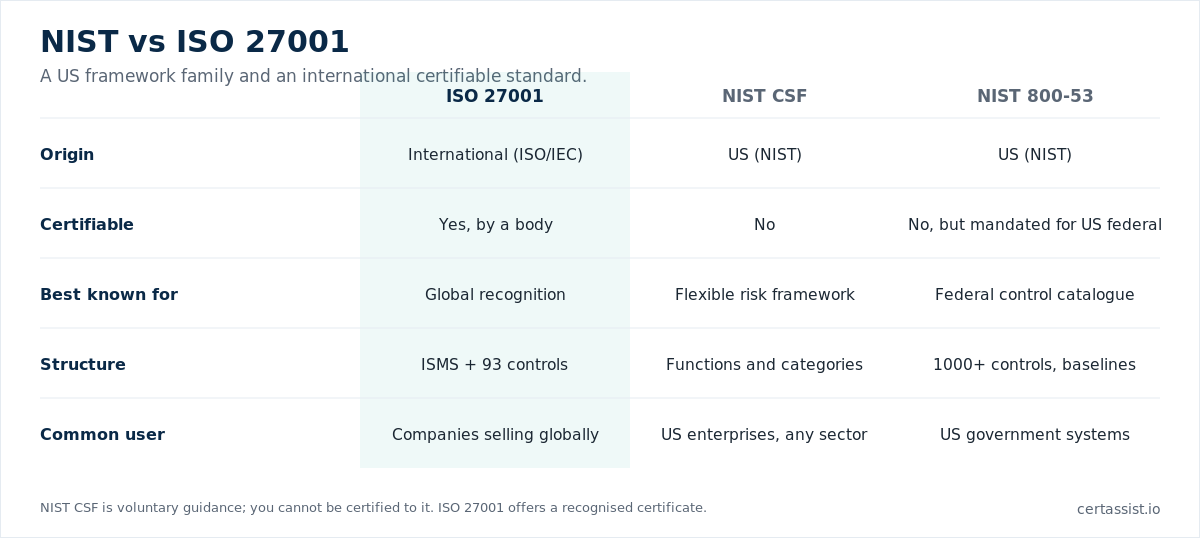
ISO 27001 is the international standard for an information security management system, published by ISO and IEC. It sets requirements for how you assess risk, set objectives, implement controls and continually improve, and it lists 93 Annex A controls in its 2022 version. Crucially, ISO 27001 supports certification: an accredited certification body audits you and issues a certificate that customers and partners recognize worldwide. That recognized certificate is the main reason companies choose ISO 27001.
NIST, the US National Institute of Standards and Technology, publishes cybersecurity guidance rather than a certification scheme. The NIST Cybersecurity Framework, or CSF, organises security into functions such as Identify, Protect, Detect, Respond and Recover, and is a flexible way to structure and communicate a program. NIST SP 800-53 is a large catalogue of security and privacy controls with baselines, mandatory for US federal information systems and their contractors. Neither is something a body certifies you against in the way ISO 27001 is.
You cannot be certified to the NIST Cybersecurity Framework, because it is voluntary guidance with no certification scheme behind it. You can align to it and self-attest, and you can be assessed against NIST 800-53 in US government contexts, but there is no NIST certificate equivalent to an ISO 27001 certificate. This is the practical reason companies that need to prove compliance to customers reach for ISO 27001 or SOC 2, while using NIST frameworks internally to organise the work.
The main difference between the NIST CSF and ISO 27001 is certification and formality. ISO 27001 is a certifiable standard with a defined management-system structure and an external audit; the NIST CSF is a flexible, voluntary framework you adopt and self-assess against. ISO 27001 is internationally recognized, which matters when selling across borders; the NIST CSF is especially common in the United States and across sectors as an organising model. They overlap heavily in the underlying controls, so aligning to one makes the other easier.
ISO 27001 and the NIST frameworks overlap substantially, because both address the same fundamentals: access control, risk management, logging, incident response, change management and so on. Published mappings link ISO 27001 Annex A controls to NIST CSF categories and 800-53 controls, so work done for one counts toward the other. In practice a team can structure its program with the NIST CSF and still pursue an ISO 27001 certificate, reusing most of the same evidence. The frameworks are complementary rather than mutually exclusive.
Choose ISO 27001 when you need a recognized certificate to satisfy customers and partners, particularly internationally, since that certificate is its main advantage. Use the NIST Cybersecurity Framework when you want a flexible model to build and communicate a program, which is common for US companies and often a stepping stone. If you sell to US federal agencies, NIST 800-53 or its derivatives may be mandatory. Many organizations sensibly do both: organise with NIST, certify with ISO 27001.
CertAssist lays out ISO 27001:2022 control by control with editable templates and a Statement of Applicability handled, so you can pursue the recognized certificate without starting from scratch, and it also covers frameworks such as SOC 2, CMMC Level 2 and others on the same board. Because the underlying controls overlap, work you organise in CertAssist for ISO 27001 supports your NIST-aligned program too. CertAssist does not integrate with your systems, and the price is a published US$225 per month during its launch.
The NIST Cybersecurity Framework has no certification fee, so on paper it is cheaper: you can download it, self-assess and align at no direct cost beyond your time. ISO 27001 carries the cost of an accredited certification body performing a two-stage audit and annual surveillance, which the NIST CSF does not. But that cost buys the very thing NIST alignment cannot give you, an independent, internationally recognized certificate that customers accept as proof. So the honest comparison is not cheaper versus dearer, it is self-attested versus independently certified. If a customer will accept your own statement that you follow NIST, that route is cheaper. If they want a certificate, ISO 27001 is the spend that actually closes the deal, and the underlying control work is largely the same either way.
Neither is better in the abstract; they do different jobs. ISO 27001 is an internationally certifiable standard, so it is better when you need a recognized certificate for customers. The NIST Cybersecurity Framework is better as a flexible model to organise a security program, especially in the United States. Many teams use NIST to structure the work and ISO 27001 to certify it.
You cannot be certified to the NIST Cybersecurity Framework, as it is voluntary guidance with no certification scheme. You can self-attest alignment, and NIST 800-53 is assessed in US federal contexts, but there is no NIST certificate equivalent to ISO 27001. Companies that must prove compliance to customers typically pursue ISO 27001 or SOC 2 instead.
ISO 27001 is a certifiable management-system standard with an external audit and international recognition. The NIST CSF is a flexible, voluntary framework you self-assess against, organised into functions like Identify, Protect and Detect. They overlap heavily in underlying controls, so aligning to one makes achieving the other easier.
Yes, substantially. Both address access control, risk management, logging, incident response and similar fundamentals, and published mappings link ISO 27001 Annex A controls to NIST CSF categories and 800-53 controls. A team can organise its program with NIST and still earn an ISO 27001 certificate, reusing most of the same evidence.
A US startup that needs to satisfy customers usually chooses ISO 27001 or SOC 2 for the recognized proof, while using the NIST Cybersecurity Framework internally to organise the program. If you sell to US federal agencies, NIST 800-53 or its derivatives such as CMMC may be mandatory, in which case NIST-based compliance comes first.
CertAssist lays out ISO 27001:2022 and other frameworks on one board with editable templates, for a published $225 a month during the launch.
See pricing FrameworksFlat $225 a month during the launch, normally $375, or $2,475 a year (12 months for the price of 11). All prices in USD.