One protects federal systems, the other protects federal data in contractor hands. Here is how 800-171 and 800-53 differ.
NIST SP 800-171 and NIST SP 800-53 are both NIST control sets, but they exist for different audiences. NIST 800-53 is the large master catalogue of security and privacy controls that US federal information systems must use, running to over a thousand controls organised into baselines. NIST 800-171 is a much smaller, tailored set, 97 requirements in its 2024 Revision 3, aimed at protecting Controlled Unclassified Information when it lives on the systems of non-federal organizations such as contractors. In short, 800-53 is for federal systems, and 800-171 is for the companies that handle federal data. Here is how they relate.
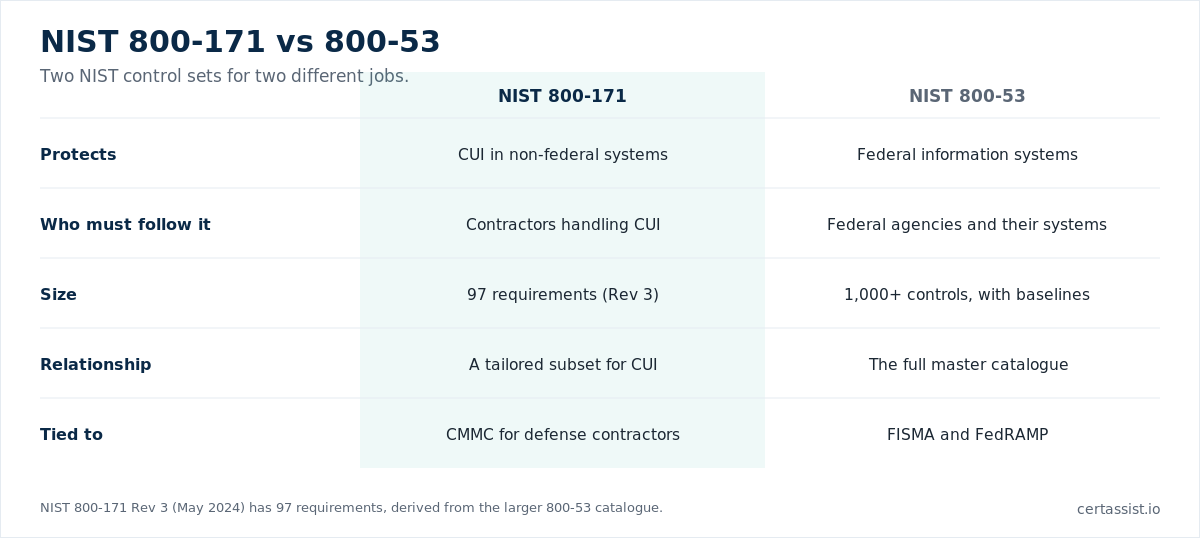
NIST SP 800-171 sets out the requirements for protecting Controlled Unclassified Information, or CUI, when it is processed, stored or transmitted by non-federal organizations. It is the standard a defense contractor or supplier must meet to handle sensitive government data that is not classified. Revision 3, published in May 2024, streamlined the standard to 97 requirements, down from 110 in Revision 2, by consolidating overlapping items. It is the security backbone of the CMMC program for the US defense industrial base.
NIST SP 800-53 is the comprehensive catalogue of security and privacy controls for US federal information systems. It contains well over a thousand controls across around twenty families, and it defines Low, Moderate and High baselines that a system selects from according to its impact level. Federal agencies use 800-53 to meet FISMA, and cloud services use it as the basis of FedRAMP authorization. It is the master source from which narrower standards, including 800-171, are derived.
NIST 800-171 is derived from NIST 800-53. NIST took the moderate-baseline controls from the larger 800-53 catalogue, tailored them to the case of protecting CUI outside federal systems, and expressed them as the shorter 800-171 requirement set. That is why the two align cleanly and why an organization meeting 800-171 is meeting a focused slice of 800-53. The relationship is subset and parent: 800-53 is the full catalogue, 800-171 is the CUI-focused tailoring of it for contractors.
NIST 800-53 applies to you if you operate a federal information system or a cloud service seeking FedRAMP authorization. NIST 800-171 applies to you if you are a non-federal organization, typically a contractor or supplier, that handles Controlled Unclassified Information under a government contract. Most private companies in the defense supply chain deal with 800-171, often through CMMC, rather than 800-53 directly. If you are unsure, the contract clauses, commonly DFARS references, tell you which applies.
The Cybersecurity Maturity Model Certification program uses NIST 800-171 as its technical foundation for the defense industrial base. CMMC Level 2 is built around the 800-171 requirements, and contractors handling CUI must demonstrate them, increasingly through a third-party assessment. So for most defense suppliers, 800-171 is not an abstract NIST document, it is the concrete checklist behind their CMMC obligation. NIST 800-53 sits above this as the federal catalogue, relevant to the government systems the contractors connect to rather than to the contractors themselves.
Revision 3 of NIST 800-171, finalised in May 2024, reduced the count to 97 requirements from 110 by merging overlapping items, and it introduced organization-defined parameters that let agencies set specific values such as password or timeout thresholds. The companion assessment guide, 800-171A Revision 3, expanded to 422 determination statements, so while there are fewer headline requirements, the assessment detail grew. If you are aligning now, work to the current revision your contract references, and confirm which revision your assessment will use.
CertAssist lays out the NIST 800-171 requirements and CMMC Level 2 practices on one board, with editable policy and evidence templates, so a contractor can work toward CMMC without an enterprise platform or system integrations. You map each requirement to the evidence that proves it and keep that evidence in one place for an assessor to review. CertAssist does not connect to your systems, which matters when the whole point is protecting sensitive data, and the price is a published US$225 per month during its launch.
Getting ready for a CMMC assessment starts with a clear inventory of where Controlled Unclassified Information lives in your business, because that scope decides which systems the 800-171 requirements apply to. From there you implement each requirement, write a System Security Plan describing how you meet it, and record a Plan of Action and Milestones for anything not yet complete. You then gather evidence that each control operates, since an assessor wants proof, not assertions. The most common reason teams stumble is leaving the System Security Plan and evidence until the end, when they are actually the spine of the assessment. Building them as you implement, control by control on a single board, turns a daunting audit into a methodical checklist and is exactly the workflow CertAssist is designed around.
NIST 800-53 is the full catalogue of security and privacy controls for US federal information systems, with over a thousand controls and Low, Moderate and High baselines. NIST 800-171 is a tailored subset, 97 requirements in Revision 3, for protecting Controlled Unclassified Information on non-federal systems such as contractors. 800-53 is for federal systems; 800-171 is for the companies handling federal data.
NIST SP 800-171 Revision 3, published in May 2024, contains 97 security requirements, reduced from 110 in Revision 2 by consolidating overlapping items. The companion assessment guide, 800-171A Revision 3, expanded to 422 determination statements, so the assessment detail grew even as the headline requirement count fell.
No, but they are closely linked. CMMC is the certification program, and NIST 800-171 provides its technical requirements. CMMC Level 2 is built around the 800-171 requirements, so a contractor demonstrating 800-171 is doing most of the work for CMMC Level 2. CMMC adds the assessment and certification process on top.
NIST 800-171 applies if your organization is non-federal and handles Controlled Unclassified Information under a government contract, which is common in the defense supply chain. Federal agencies and their systems use NIST 800-53 instead. Your contract clauses, often DFARS references, state whether 800-171 applies to you.
Yes. NIST built 800-171 by taking moderate-baseline controls from the larger 800-53 catalogue and tailoring them to protecting CUI on non-federal systems. That is why the two align cleanly and why meeting 800-171 satisfies a focused slice of 800-53. The catalogue is the parent; 800-171 is the CUI-focused subset.
CertAssist lays out NIST 800-171 and CMMC Level 2 with editable evidence templates, for a published $225 a month during the launch.
See pricing FrameworksFlat $225 a month during the launch, normally $375, or $2,475 a year (12 months for the price of 11). All prices in USD.