SOC 2 suits businesses selling mainly to North American customers who want an independent attestation report. ISO 27001 suits businesses that need a certified, internationally recognized information security management system, particularly if you sell outside North America. Many growing companies eventually hold both, because the two frameworks share a large set of common controls.
If you have gotten this far because a customer, a security questionnaire or a board member has asked "SOC 2 or ISO 27001?", the honest answer is that it depends on who is asking and where they are. Below is the practical breakdown: what each framework actually is, what each one costs, and a straightforward way to decide which to pursue first.
SOC 2 is an attestation, not a certification. A licensed CPA firm examines your controls against the AICPA's Trust Services Criteria and issues an opinion, called a SOC 2 report, that you share directly with customers under NDA. There is no logo, no certificate and no public registry. SOC 2 is the de facto standard requested by North American SaaS buyers. If you are earlier in that journey, our guide to SOC 2 for startups covers when you actually need it.
ISO 27001 is a certification. An accredited certification body audits your information security management system, or ISMS, against the ISO/IEC 27001:2022 requirements and Annex A controls, then issues a certificate valid for three years, subject to annual surveillance audits. ISO 27001 is the standard most commonly requested by customers, regulators and partners outside North America. See our breakdown of what ISO 27001 certification costs for the full picture.
Both frameworks cover the same territory in practice: access control, risk management, incident response, vendor management, encryption, logging and continuous improvement. The paperwork and the auditor relationship differ; the underlying security work does not differ nearly as much.
| Factor | SOC 2 | ISO 27001 |
|---|---|---|
| What you get | An attestation report shared privately with customers | A public certificate valid for three years |
| Governing body | AICPA (Trust Services Criteria) | ISO and IEC (ISO/IEC 27001:2022) |
| Who audits you | A licensed CPA firm | An accredited certification body |
| Typical audience | North American B2B SaaS buyers | International customers, government and regulated sectors |
| Report types | Type I (point in time) or Type II (3 to 12 month observation window) | Stage 1 and Stage 2 initial audit, then annual surveillance |
| Renewal cycle | Typically annual | 3 year certificate, audited annually |
| Typical timeline to first report or certificate | 2 to 4 months for Type I, plus the observation window for Type II | 3 to 6 months |
SOC 2 is usually the better first move for a business selling to US and Canadian mid-market or enterprise buyers. It is what their security teams expect to see, their questionnaires are often mapped to the Trust Services Criteria, and a SOC 2 Type I report can unblock a deal in weeks rather than months. If nobody outside North America is asking you for a certificate, ISO 27001 can wait.
ISO 27001 tends to matter more once you sell into Europe, the Middle East, Asia Pacific or to government and regulated customers anywhere. Procurement teams outside North America are often unfamiliar with SOC 2 and will ask for "the ISO certificate" specifically. If your pipeline includes government tenders, multinational enterprise customers, or partners in a country where ISO certification is culturally the default proof point, start there.
Neither framework has one fixed price. The final bill depends on your headcount, how many systems are in scope and how mature your controls already are. As a rough guide for a small business, in USD:
| Cost component | SOC 2 (typical range) | ISO 27001 (typical range) |
|---|---|---|
| Independent audit or certification body fee | US$7,000 to US$15,000 for Type I; US$12,000 to US$30,000 for Type II | US$10,000 to US$30,000 for the initial Stage 1 and Stage 2 audit |
| Ongoing annual cost | Similar range each year, since SOC 2 reports are typically renewed annually | US$3,000 to US$8,000 a year for surveillance audits, then a fuller recertification audit in year three |
| Consultant or fractional expert, if used | US$5,000 to US$20,000, depending on scope | US$5,000 to US$25,000, depending on scope |
| Compliance platform | Ranges from free spreadsheets to several hundred or several thousand US dollars a month | Same range applies |
| Your own team's time | Real, and usually the most underestimated cost | Real, and usually the most underestimated cost |
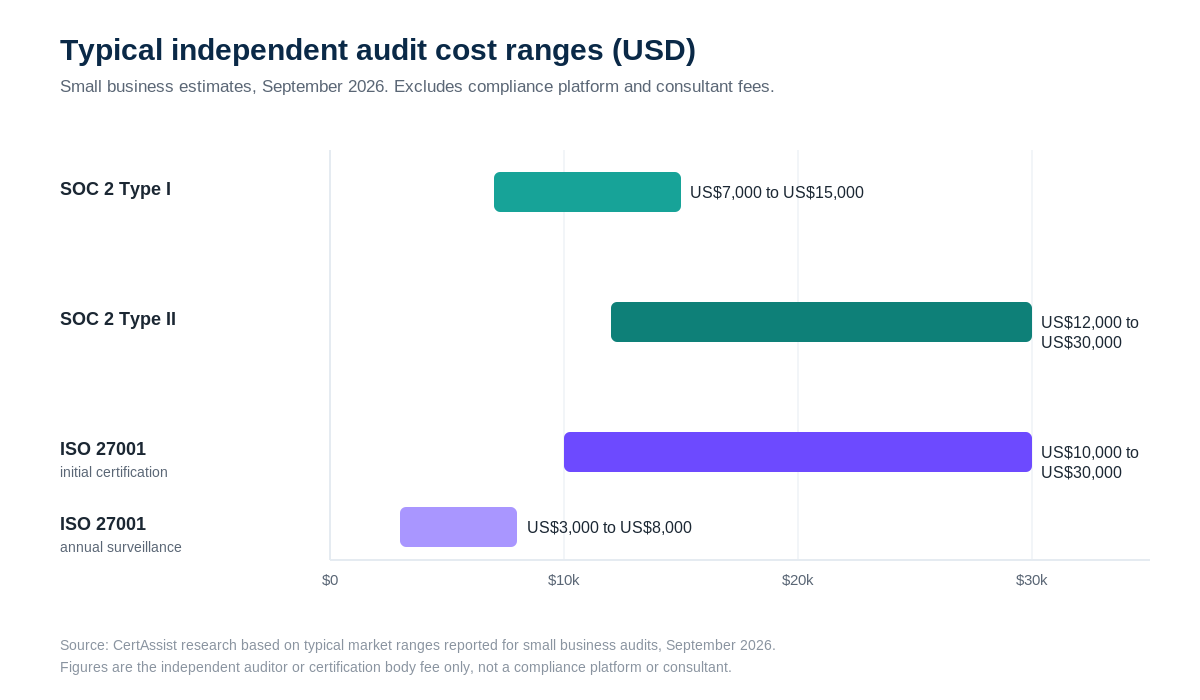
Two things are worth being upfront about. First, the audit fee is paid to an independent CPA firm or certification body, never to a compliance platform, and no platform can shortcut that independent review. Second, most enterprise compliance platforms do not publish their own price, which makes it hard to know the true all-in cost before you talk to sales. As of September 2026, CertAssist publishes its price openly: a limited-time launch rate of US$225 a month, normally US$375 a month, or US$2,475 a year, which is 12 months for the price of 11.
Yes, and a lot of scaling companies do exactly that. Because SOC 2 and ISO 27001 share a large amount of common ground, mainly around access control, risk assessment, incident response and vendor management, compliance vendors commonly describe the control overlap as running from roughly 40 to 85 percent depending on how strictly you map one framework's language to the other's. Once you have built the underlying controls and evidence for one framework, extending the same evidence base to cover the second is materially cheaper and faster than starting from nothing. Many businesses run SOC 2 Type I first to unblock an immediate deal, then layer ISO 27001 on top once international demand justifies it.
CertAssist lays out the SOC 2 Trust Services Criteria and the ISO 27001:2022 controls on one board, with editable policy and evidence templates for each so you are not starting from a blank page, and it handles the Statement of Applicability that ISO 27001 requires. Your auditor gets read-only access to review evidence directly, which shortens the back and forth that usually slows an audit down. Because CertAssist does not connect to your cloud, identity provider or code, there is nothing to integrate and nothing extra for an attacker, or an auditor, to worry about. The trade-off is honest: you lose the automated evidence pulled by tools that do connect to your systems, and you gain simplicity, a much lower price, and one less system with access to your infrastructure. For a small team pursuing SOC 2, ISO 27001, or both, that trade-off is usually the right one. CertAssist does not replace your independent auditor or certification body; it simply makes their job, and yours, easier.
What is the difference between SOC 2 and ISO 27001?
SOC 2 is a US attestation report issued by a CPA firm against the AICPA's Trust Services Criteria and shared privately with customers. ISO 27001 is an internationally recognized certification issued by an accredited certification body against an information security management system, and it results in a public, three-year certificate rather than a private report.
Is SOC 2 equivalent to ISO 27001?
Not exactly, though they overlap heavily. Both cover similar security domains, such as access control and incident response, but SOC 2 is an attestation aimed mainly at North American buyers while ISO 27001 is a certification recognized globally. Neither one automatically satisfies a request for the other, though the evidence you gather for one substantially speeds up getting the second.
Which is better, SOC 2 or ISO 27001, for a small company?
It depends on your buyers. If your customers are mostly in the US and Canada, SOC 2 is usually the faster, more directly useful choice. If your customers or regulators are outside North America, ISO 27001 usually carries more weight. Many small companies start with whichever one an active deal is actually asking for.
Can you get both SOC 2 and ISO 27001 at the same time?
Yes. Because the two frameworks share a large proportion of common controls, many companies pursue SOC 2 first to unblock a North American deal, then add ISO 27001 once international demand appears, reusing much of the same policy and evidence work rather than starting again.
How much does SOC 2 vs ISO 27001 cost?
For a small business, SOC 2 Type I audits typically run from US$7,000 to US$15,000, and Type II from US$12,000 to US$30,000. Initial ISO 27001 certification typically runs from US$10,000 to US$30,000, plus smaller annual surveillance audit fees. These figures cover the independent audit only, not any compliance platform or consultant.
CertAssist lays out every control for both frameworks, gives you editable policy and evidence templates, and lets your auditor review it all in one place, from US$225 a month during the current launch offer.
See pricing FrameworksFlat $225 a month, or $2,475 a year (12 months for the price of 11). All prices in USD.