Type I is a snapshot of control design. Type II proves controls operated over months. Here is which one to get, and when.
A SOC 2 Type I report assesses whether your controls are designed properly at a single point in time, while a SOC 2 Type II report assesses whether those controls actually operated effectively over a period, commonly three to twelve months. Type I is faster and cheaper and can unblock an early deal; Type II is stronger and is what most serious buyers eventually require. A common path is to get Type I first, then Type II over the following months. Here is how they differ and which to get first.
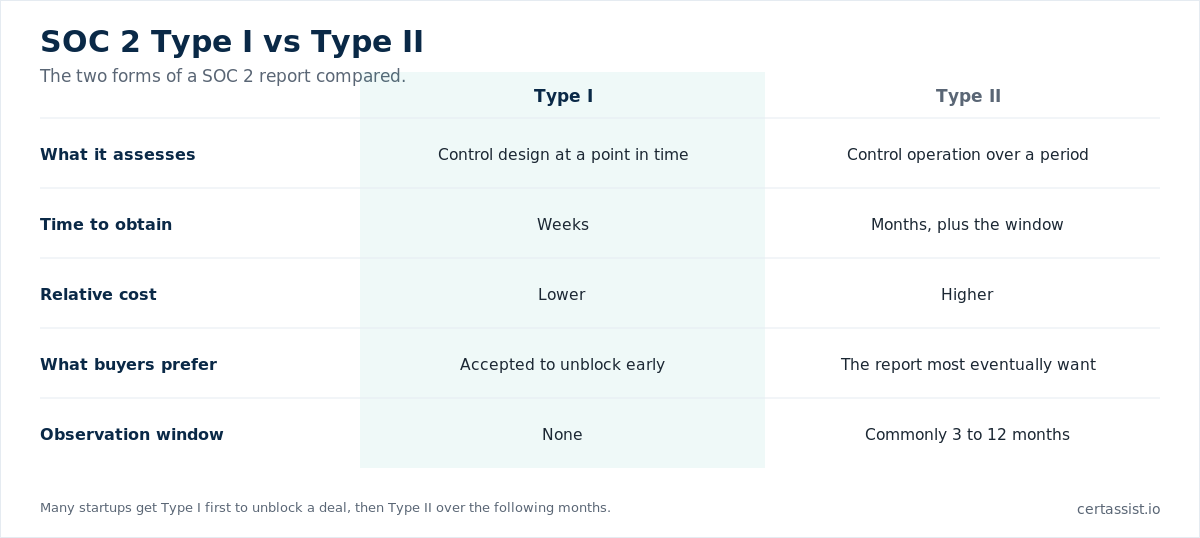
A SOC 2 Type I report is an auditor's opinion on whether your controls are suitably designed to meet the Trust Services Criteria as at a specific date. It is a snapshot: the auditor checks that the right controls exist and are set up correctly, but not that they have been running over time. Because there is no observation window, a Type I can be completed in weeks once your controls and evidence are in place, which is why startups use it to answer a customer quickly.
A SOC 2 Type II report is an auditor's opinion on whether your controls were not only designed properly but also operated effectively across a period of time. The auditor samples evidence from throughout an observation window, commonly three to twelve months, to confirm the controls ran consistently. This is a stronger assurance than Type I, and it is the report most enterprise buyers, security teams and procurement functions ultimately ask to see, which is why Type II is the destination even when Type I is the first step.
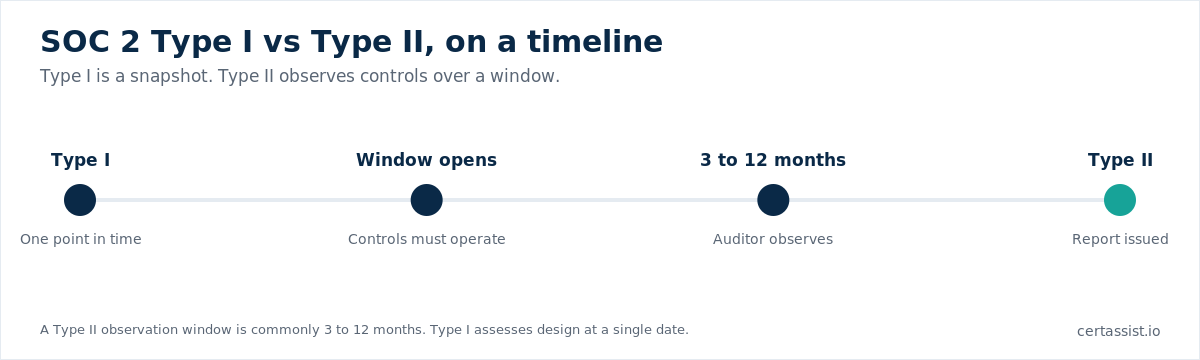
The SOC 2 Type II observation window is commonly three to twelve months. A first Type II often uses a shorter window of three to six months to reach a report sooner, and later renewals typically cover a full twelve months so the report is continuous year to year. The window is set before the audit begins, and the auditor collects evidence from across it, so your controls need to be operating and generating evidence for the whole period, not just at the end.
Get Type I first if you need to unblock a specific deal quickly and the customer will accept it as interim assurance, because it is faster and cheaper. Go straight to Type II if you have time and your buyers require operating effectiveness, since you will need Type II eventually and skipping Type I saves one audit fee. The most common startup pattern is Type I to answer an urgent request, then a Type II window running immediately afterward so the stronger report follows a few months later.
Yes, SOC 2 Type II generally costs more than Type I, because the auditor examines evidence across an entire observation window rather than at a single date, which is more work. There is also the indirect cost of maintaining and evidencing controls throughout the window. The exact figures depend on scope and firm, but expect Type II to sit at the higher end of audit-fee ranges. Getting Type I and then Type II means paying for two examinations, which is the trade for unblocking a deal sooner.
CertAssist keeps your SOC 2 controls and evidence organised continuously, which is exactly what a Type II needs, because a Type II depends on evidence existing across the whole window rather than being assembled at the last minute. You lay out the Trust Services Criteria on one board, keep evidence attached to each control as you go, and give your auditor read-only access for either a Type I or a Type II examination. CertAssist does not integrate with your systems, so there is nothing to breach, and the price is a published US$225 per month during its launch.
Which SOC 2 report a customer accepts depends on where they are in their own risk process. Many enterprise buyers will accept a Type I to let a deal proceed, on the understanding that a Type II is coming, because they would rather onboard you now with a plan than wait months. Security-mature buyers, regulated industries and larger procurement teams often insist on a Type II before granting access to sensitive data, since operating effectiveness over time is what they are assuring. The safe move is to ask the customer directly what they require and by when, then decide whether to unblock with a Type I and follow with a Type II, or go straight to Type II. Guessing wastes an audit cycle, and the answer is usually one email away.
A SOC 2 Type 1 report assesses whether controls are designed correctly at a single point in time. A SOC 2 Type 2 report assesses whether those controls also operated effectively over a period, commonly three to twelve months. Type 2 is the stronger assurance and the one most buyers eventually require.
Get Type 1 first if you need to unblock a deal quickly and the customer accepts it as interim assurance, because it is faster and cheaper. Go straight to Type 2 if you have time and buyers require operating effectiveness. Many startups do Type 1 first, then start a Type 2 window immediately afterward.
The observation window is commonly three to twelve months. A first Type 2 often uses three to six months to reach a report sooner, and renewals usually cover a full twelve months for continuous coverage. Controls must operate and produce evidence across the whole window, not just at the end.
Yes. Type 2 generally costs more because the auditor examines evidence across an entire observation window rather than at one date, which is more work, plus the cost of maintaining controls throughout. Getting Type 1 then Type 2 means paying for two examinations, which is the trade for unblocking a deal sooner.
A SOC 2 report reflects a date or period, and buyers generally expect a report no older than twelve months, so in practice a Type 1 becomes stale within a year. Because most buyers ultimately want Type 2, a Type 1 is best treated as a stepping stone to a Type 2 rather than something you renew indefinitely.
CertAssist keeps your SOC 2 evidence organised across the whole observation window, for a published $225 a month during the launch.
See pricing FrameworksFlat $225 a month during the launch, normally $375, or $2,475 a year (12 months for the price of 11). All prices in USD.