SOC 2 is a report you choose to get. HIPAA is a law you must follow. Here is how they overlap, and when you need each.
SOC 2 and HIPAA are often mentioned together but they are different kinds of thing. SOC 2 is a voluntary attestation, an independent auditor's report on your security controls against the AICPA Trust Services Criteria, chosen by a business to reassure customers. HIPAA is a US law that legally requires anyone handling protected health information to protect it, whether they want to or not. A SOC 2 report is not HIPAA compliance, though the two overlap heavily, and a healthcare company often needs both. Here is how they compare and when each applies.
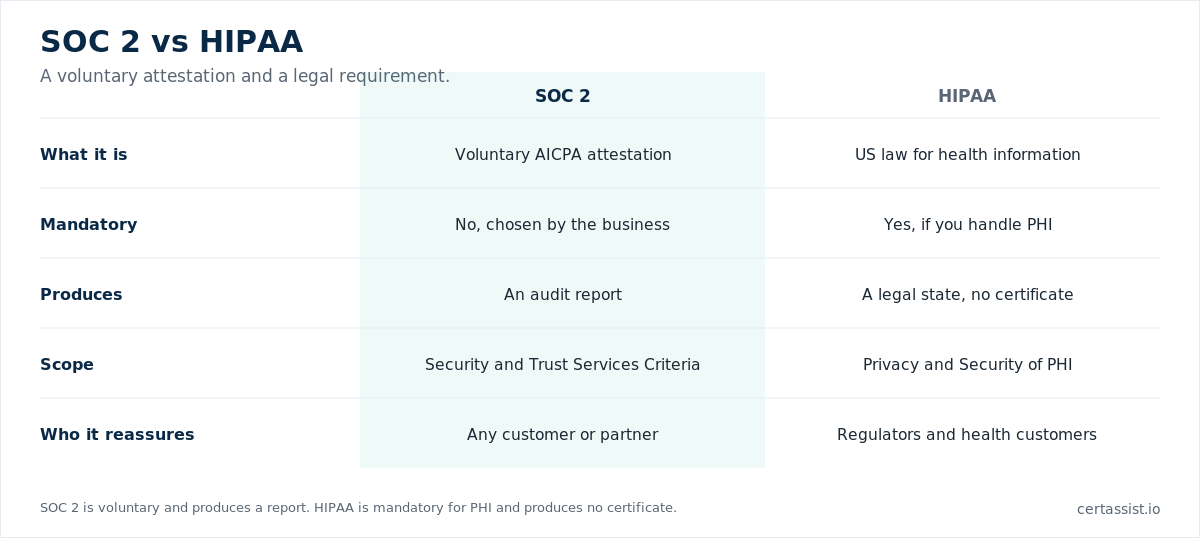
SOC 2 is a reporting standard from the American Institute of CPAs under which an independent auditor examines your controls against the Trust Services Criteria, with Security as the mandatory core. It results in a report, in Type I or Type II form, that you share with customers under NDA to demonstrate that your security controls are designed and, for Type II, operating effectively. SOC 2 is voluntary: no law requires it, but customers frequently do, which is why technology companies pursue it.
HIPAA is a US federal law whose Privacy and Security Rules require covered entities and their business associates to protect protected health information. Unlike SOC 2, HIPAA is not optional and not a report: if you handle PHI, you are legally obligated to meet its requirements, and the HHS Office for Civil Rights can investigate and fine non-compliance. HIPAA produces no certificate, so organizations demonstrate it through documented controls, risk analysis and, often, a related attestation.
The core difference is that SOC 2 is a voluntary attestation and HIPAA is a mandatory law. SOC 2 gives you a report about your security controls that any customer can rely on; HIPAA imposes a legal duty specifically about health information and gives you no certificate. SOC 2 is chosen; HIPAA is required whenever PHI is involved. They overlap in the controls they expect, such as access control and encryption, but one is a business decision and the other is the law.
No, a SOC 2 report does not make you HIPAA compliant. SOC 2 assesses controls against the Trust Services Criteria, not against HIPAA's specific Privacy and Security Rule requirements, so passing a SOC 2 does not by itself satisfy the law. That said, many of the controls overlap, and some auditors offer a SOC 2 examination that maps in HIPAA requirements, sometimes called a SOC 2 plus HIPAA report. Even then, HIPAA compliance is a legal state you maintain, not something a report grants.
A healthcare technology company often needs both, because they serve different purposes. If you handle PHI you are legally required to meet HIPAA regardless of anything else. If your customers also ask for proof of your security posture, a SOC 2 report is the common way to provide it. So HIPAA is the floor set by law, and SOC 2 is the evidence many buyers want on top. Confirm which your specific customers require, since some accept a SOC 2 with HIPAA mapping and others expect both separately.
If you handle PHI, treat HIPAA as non-negotiable and address it first, because it is a legal obligation with real penalties. Pursue SOC 2 in parallel or next when customers ask for an independent report, since much of the underlying control work, access management, encryption, logging, incident response, serves both. Sequencing this way keeps you on the right side of the law while building toward the report that unblocks sales. The shared controls mean the second effort is much lighter than the first.
CertAssist lays out SOC 2 and HIPAA on the same board, so the controls they share are done once and mapped to both, with editable policy and evidence templates and read-only auditor access. You maintain your HIPAA risk analysis and policies and organise your SOC 2 evidence in one place, ready for an auditor or an investigator. CertAssist does not connect to your systems, which is reassuring with health data in scope, and the price is a published US$225 per month during its launch.
SOC 2 is a voluntary attestation in which an auditor reports on your security controls against the Trust Services Criteria. HIPAA is a US law that mandates protecting health information whenever you handle it. SOC 2 is chosen and produces a report; HIPAA is required and produces no certificate. They overlap in controls but are different kinds of obligation.
Not automatically. SOC 2 assesses controls against the Trust Services Criteria, not against HIPAA's specific rules, so a SOC 2 report does not by itself make you HIPAA compliant. Many controls overlap, and some auditors offer a SOC 2 plus HIPAA report that maps in HIPAA requirements, but HIPAA compliance remains a legal state you maintain.
Often yes. If you handle protected health information you are legally required to meet HIPAA regardless. If customers also want proof of your security, a SOC 2 report is the usual way to provide it. HIPAA is the legal floor; SOC 2 is the evidence buyers request on top. Confirm what your specific customers accept.
They are hard in different ways. HIPAA is a broad legal requirement with no checklist blessed by the regulator, so scoping it well takes judgment. SOC 2 has a defined framework and an external audit, which is structured but involves auditor fees and an observation window for Type II. Because the controls overlap, doing one makes the other significantly easier.
If you handle PHI, address HIPAA first because it is a legal obligation with penalties. Pursue SOC 2 in parallel or next when customers ask for an independent report. Much of the control work, access management, encryption, logging, incident response, serves both, so sequencing this way keeps you compliant while building toward the report that unblocks sales.
CertAssist maps SOC 2 and HIPAA on one board with editable templates, for a published $225 a month during the launch.
See pricing FrameworksFlat $225 a month during the launch, normally $375, or $2,475 a year (12 months for the price of 11). All prices in USD.