Secureframe automates evidence through integrations. If you would rather skip the access and know the price, here are your options.
Secureframe is a compliance automation platform that integrates with your cloud, identity and code to collect evidence automatically for frameworks such as SOC 2 and ISO 27001. A common alternative, especially for smaller teams, is a lighter tool that skips the integrations entirely and publishes its price, such as CertAssist at US$225 per month during its launch. Other alternatives in the same automation category include Vanta, Drata and Sprinto. The right choice depends on whether you value automated evidence collection at scale, or simplicity, no system access and a predictable cost. Here is an honest comparison.
Secureframe is a compliance automation platform that helps companies achieve and maintain certifications such as SOC 2 and ISO 27001. It connects to your infrastructure and tools, pulls evidence automatically, maps it to a framework, and monitors continuously so you stay audit ready between audits. It also provides policy templates, guided remediation and an auditor portal. Secureframe is a capable, well regarded tool, and like its peers it is built around integrations, with an entry package priced from US$7,500 a year and everything above it quoted after a sales demo.
People look for a Secureframe alternative for three main reasons. The first is price: like most of the category, Secureframe quotes most of its packages after a demo, and the negotiated cost can be more than a small team wants to spend. The second is system access: automated evidence collection requires broad, ongoing access to your cloud, identity provider and often your code, which some teams would rather not grant. The third is fit: a small company pursuing a first certification may not need continuous monitoring across many integrations. None of these is a criticism of Secureframe; they are simply reasons a lighter tool can suit better.
When weighing a Secureframe alternative, look at the evidence model and what access it demands, the pricing transparency, the frameworks covered, and the fit for your size. Decide whether automated collection is worth the system access it requires, or whether you would rather upload evidence yourself and keep your systems untouched. Check that the price is one you can confirm without a sales process, and that the frameworks you need are supported. Above all, match the tool to the scale of your problem rather than buying the most capable platform by default.
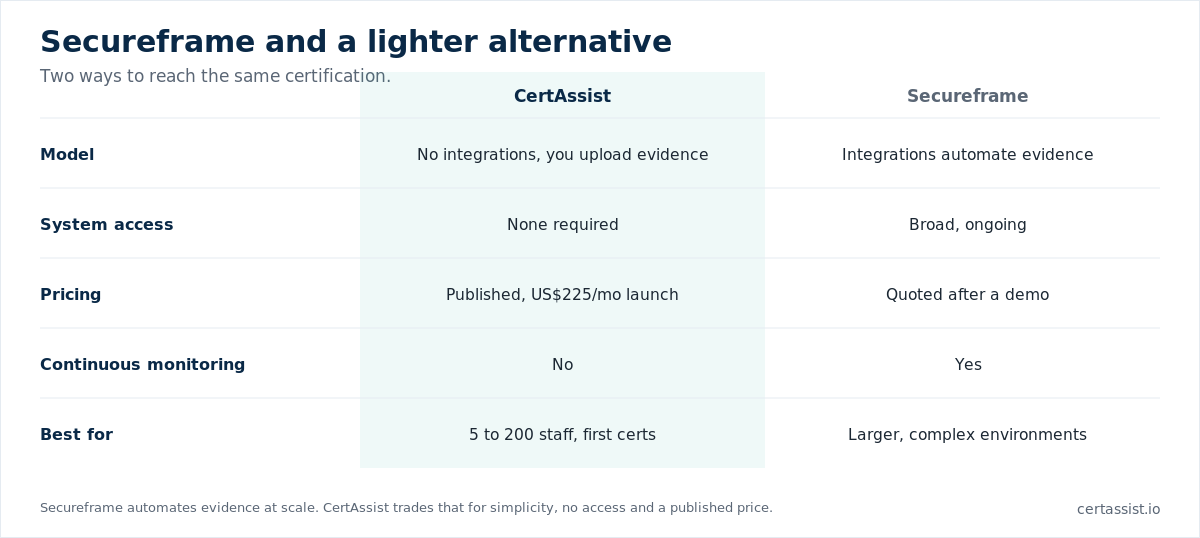
CertAssist is a deliberately lighter alternative to Secureframe. It lays out every control in a framework, gives you editable policy and evidence templates, handles your Statement of Applicability, and provides read-only auditor access, all without connecting to your systems. You upload the evidence you choose, so there is no integration to set up and no standing access to govern. The price is published, US$225 per month during its launch and normally US$375, so you can budget without a demo. The trade is clear: you give up automated collection and continuous monitoring, and you gain simplicity, no system access and a predictable, low cost.
Vanta, Drata and Sprinto are the other well known alternatives in the compliance automation category, and they are similar to Secureframe in shape: integration-based evidence collection, continuous monitoring, broad framework coverage, and pricing by demo. Vanta has the widest adoption and integration catalogue, Drata is often praised for onboarding, and Sprinto positions toward fast-moving cloud startups. If you have decided you want automated, integrated compliance, these are worth comparing alongside Secureframe on quote and integrations. If you have decided you want simplicity and a published price, a no-integration tool is the different path.
A lighter alternative to Secureframe is right for you if you are a team of roughly 5 to 200 people pursuing a first SOC 2 or ISO 27001, you would rather not grant broad system access, and you want to know the price upfront. It is not right if you run a large, complex environment where automated evidence collection saves meaningful time, or if a customer specifically requires continuous monitoring. Be honest about which describes you, because the best tool is the one that fits your size, not the one with the longest feature list.
Yes, you can get SOC 2 without Secureframe or any specific platform. SOC 2 requires an independent CPA firm to examine your controls and issue the report, and no tool performs or replaces that. A platform simply organises your controls and evidence for the auditor, and you can do that with a lighter tool such as CertAssist, with a spreadsheet, or with any of the automation platforms. The certificate comes from the auditor; the tool just makes getting there tidier. Choose the tool that matches how much help you actually need.
Alternatives fall into two camps. In the same automation category sit Vanta, Drata and Sprinto, which also use integrations and quote by demo. In the lighter camp is CertAssist, which skips integrations, publishes its price at US$225 per month during its launch, and has you upload evidence yourself. The right one depends on whether you want automation at scale or simplicity and a known price.
Secureframe is worth it for teams that value automated evidence collection and continuous monitoring across many integrations and have the budget for a demo-quoted platform. It is a capable, well regarded tool. It is less suited to a small team pursuing a first certification that would rather not grant broad system access or spend at that level, where a lighter alternative fits better.
Secureframe publishes an entry price for its Fundamentals package, from US$7,500 a year as at October 2026, and quotes its Complete and Defense packages after a sales demo. Your final cost depends on the package and the quote. By contrast, CertAssist publishes a flat US$225 per month during its launch, normally US$375, so you can budget without a sales process.
Secureframe automates evidence collection by integrating with your systems and monitors continuously, quoted by demo. CertAssist takes no system access; you upload the evidence you choose, and the price is published. Secureframe suits larger, complex environments that value automation; CertAssist suits teams of 5 to 200 that want simplicity, no access and a predictable, low cost.
Yes. SOC 2 requires an independent CPA firm to examine your controls and issue the report, and no platform performs or replaces that. A tool just organises your controls and evidence for the auditor, which you can do with a lighter option like CertAssist, a spreadsheet, or any automation platform. The certificate comes from the auditor, not the software.
CertAssist lays out every control with editable templates and auditor access, no integrations, for a published $225 a month during the launch.
See pricing FrameworksFlat $225 a month during the launch, normally $375, or $2,475 a year (12 months for the price of 11). All prices in USD.