The three big compliance automation platforms are more alike than different. Here is what actually separates them, and when a lighter tool wins.
Drata, Vanta and Secureframe are the three best known compliance automation platforms, and for most buyers they are more alike than different. All three automate evidence collection for SOC 2, ISO 27001 and other frameworks by integrating deeply with your cloud, identity provider and code, and all three sell mainly through a sales demo, with Secureframe the only one showing even an entry price. They differ at the edges on framework coverage, onboarding and support. If you are a team of 5 to 200 people that simply needs a certification without granting broad system access or paying an enterprise price, a lighter tool such as CertAssist, at US$225 per month during its launch, is worth weighing against all three. Here is the honest comparison.
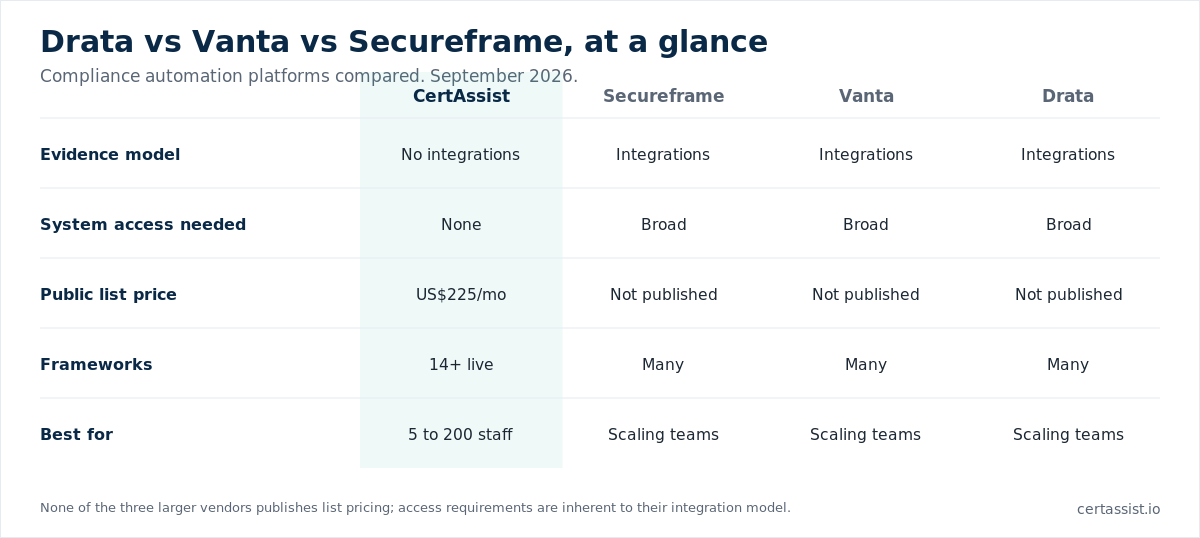
Drata, Vanta and Secureframe are compliance automation platforms. Each connects to your infrastructure, pulls configuration and access data automatically, maps that evidence to a framework such as SOC 2 or ISO 27001, and flags gaps continuously so you are audit ready between audits. That automation is genuinely valuable once you run a larger, complex environment, because collecting the same evidence by hand every quarter is slow. It is the core of what you pay for.
Drata, Vanta and Secureframe share the same shape. All three rely on integrations to collect evidence, support the common frameworks, include policy templates and an auditor portal, and sell mainly through a demo rather than a public price. Choosing between them usually comes down to which sales team you preferred, which integrations you specifically need, and the quote each returns for your company size. The differences are real but incremental.
Vanta is the most widely adopted and has the largest integration catalogue and partner network. Drata competes closely and is often praised for onboarding and support. Secureframe positions around guided remediation and managed help. In practice a small buyer will find all three capable, and the deciding factor is the quote and the specific integrations on offer rather than a feature nobody else has.
Drata and Vanta publish no list pricing, and Secureframe publishes only an entry figure: its Fundamentals package from US$7,500 a year as at October 2026, with higher packages quoted. So for most buyers the honest answer is that you will not know your cost until you have been through a demo. Vanta's pricing page lists four plans and asks you to request a demo for personalized pricing, and notes that the entry plan covers one framework. Because the number is negotiated and gated, you cannot confirm your cost without entering a sales process. CertAssist takes the opposite approach and publishes its price openly: US$225 per month during the launch, normally US$375, or US$2,475 per year.
Drata, Vanta and Secureframe all require broad, ongoing access to your cloud, identity provider and often your code, because that access is how they collect evidence automatically. That is a fair trade at scale, but third party access is now a leading breach vector, and every integration is another set of credentials to govern. CertAssist deliberately takes none of that access. It gives you the controls, editable templates and an auditor view, and you upload the evidence you choose. You lose automated collection and continuous monitoring, and you gain simplicity, no system access and a far lower price. For a small team, that is often the better trade.
If you run a larger environment, need continuous monitoring across many frameworks, and have the budget, Drata, Vanta or Secureframe will serve you well, and you should pick on the quote and the integrations you need. If you are a team of 5 to 200 that needs to pass a first SOC 2 or ISO 27001 without granting cloud admin or signing a five figure contract, CertAssist covers the same standards for a published, flat price. Match the tool to the size of the problem.
On framework coverage the four tools are broadly comparable: Drata, Vanta and Secureframe each support SOC 2, ISO 27001 and a long list of others, and CertAssist covers 14 or more live frameworks including SOC 2, ISO 27001:2022, HIPAA, GDPR, PCI DSS v4.0.1, CMMC Level 2 and the Essential Eight. Support is where price shows. The integration-based platforms bundle onboarding help and, on higher tiers, managed services, which is part of what the larger quote pays for. CertAssist keeps support lighter and the product simpler, on the view that a small team working a first certification needs clear templates and a tidy board more than a managed program. Neither approach is wrong; they suit different sizes of buyer.
The most common mistake is buying for a scale you do not have yet. A ten person company rarely needs dozens of live integrations and continuous monitoring to pass its first audit, yet it can end up paying enterprise rates for them. The second mistake is treating the platform price as the whole cost and forgetting the independent audit, which is a separate fee no tool includes. The third is granting broad system access without governing it, which quietly adds risk. Decide what you actually need this year, confirm the audit fee separately, and weigh what each tool asks of your systems, not just what it charges.
For a small team, a lighter alternative to Vanta or Drata is often worth it, because the value those platforms add most, automated evidence collection at scale, is the value a small environment needs least. When you have a handful of systems, collecting evidence by hand once or twice a year is manageable, and you avoid both the enterprise price and the standing system access. The honest exception is if you already run a complex, fast changing environment where manual evidence would genuinely slow you down, or if you must satisfy a customer who insists on continuous monitoring. Outside those cases, a published, flat rate tool such as CertAssist at US$225 per month during its launch does the job of getting you certified, and you can always move to a heavier platform later if you outgrow it. The right call is the smallest tool that passes your audit, not the most capable one on the market.
Drata and Vanta are closely matched. Vanta has the largest integration catalogue and the widest adoption, while Drata is often rated highly for onboarding and support. For a small team the practical difference is minor, so the deciding factors are usually the quote you receive and the specific integrations you need rather than one platform being clearly better.
Drata and Vanta publish no list pricing and quote per company after a sales demo. Secureframe lists its entry Fundamentals package from US$7,500 a year as at October 2026 and quotes the rest. For most buyers, your cost is whatever the quote says. You cannot confirm your price without entering a sales process, which is why gated pricing frustrates smaller teams.
For a startup that needs a first SOC 2 or ISO 27001 without a large budget, a lighter tool is often the better fit. CertAssist gives you the controls, editable templates and auditor access for a published US$225 per month during its launch, with no system integrations, while Drata, Vanta and Secureframe are built for continuous monitoring at larger scale.
No. Integrations automate evidence collection, which saves time at scale, but they are not a requirement of SOC 2. An auditor needs to see that your controls exist and operate, and you can provide that evidence manually. CertAssist is built around this: no integrations, no system access, and you upload the evidence you choose.
Cheapest depends on scope, and most platforms hide their price behind a demo. CertAssist publishes a flat rate of US$225 per month during its launch (normally US$375), which is typically well below negotiated quotes from the integration-based platforms. Remember the tool is only part of the cost: the independent audit is a separate fee.
CertAssist lays out every control, gives you editable templates, and lets your auditor review it in one place, for a published $225 a month during the launch.
See pricing FrameworksFlat $225 a month during the launch, normally $375, or $2,475 a year (12 months for the price of 11). All prices in USD.