What ISO 14001 certification really costs in 2026, the audit days that set the certification body fee, and why environmental complexity matters as much as headcount.
ISO 14001 certification costs a small US organisation of fewer than 10 people at a single site roughly US$5,000 to US$8,000 for initial certification, according to accredited certification body Amtivo, and more as headcount and environmental impact grow. The audit fee follows audit days, which IAF MD 5:2023 sets by headcount and by the environmental complexity of your work: 2.5 days for a five person office, 5.5 days for a 20 person chemicals business. A consultant, if you use one, adds US$500 to US$1,500 a day.
ISO 14001 certification cost splits into the certification body audit, which is close to fixed once your audit days are known, and preparation, which you control. Very few providers publish ISO 14001 figures specifically, so the table below attributes every number to its source.
| Cost component | Published 2026 US figure | Source |
|---|---|---|
| Copy of the ISO 14001 standard | About US$160 | Amtivo |
| Initial certification, fewer than 10 people, one site | US$5,000 to US$8,000 | Amtivo |
| Consultant, optional | US$500 to US$1,500 per day | Amtivo |
| Stage 1 audit, ISO standards generally | US$2,000 to US$8,000 | ZenGRC |
| Stage 2 audit, ISO standards generally | US$5,000 to US$25,000 | ZenGRC |
| Annual surveillance audit, ISO standards generally | US$3,000 to US$12,000 per year | ZenGRC |
| Your own team's time | Not a fee, usually the largest cost | Your payroll |
The ZenGRC ranges cover ISO certification in general and stretch to large organisations, so a small, low impact business should expect to sit at the bottom of them. The figure that actually separates a US$5,000 ISO 14001 project from a US$25,000 one is whether you pay a consultant to build the environmental management system for you.
ISO 14001 audit days are the number that sets the certification body fee, and almost no cost guide publishes them. Accredited certification bodies calculate ISO 14001 audit duration from IAF MD 5:2023, Table EMS 1, then price per audit day. Unlike ISO 9001, where only headcount matters, ISO 14001 audit time also depends on the complexity category of your environmental aspects.
| Effective number of personnel | High complexity | Medium | Low | Limited |
|---|---|---|---|---|
| 1 to 5 | 3 | 2.5 | 2.5 | 2.5 |
| 6 to 10 | 3.5 | 3 | 3 | 3 |
| 11 to 15 | 4.5 | 3.5 | 3 | 3 |
| 16 to 25 | 5.5 | 4.5 | 3.5 | 3 |
| 26 to 45 | 7 | 5.5 | 4 | 3 |
| 46 to 65 | 8 | 6 | 4.5 | 3.5 |
| 66 to 85 | 9 | 7 | 5 | 3.5 |
| 86 to 125 | 11 | 8 | 5.5 | 4 |
| 126 to 175 | 12 | 9 | 6 | 4.5 |
| 176 to 275 | 13 | 10 | 7 | 5 |
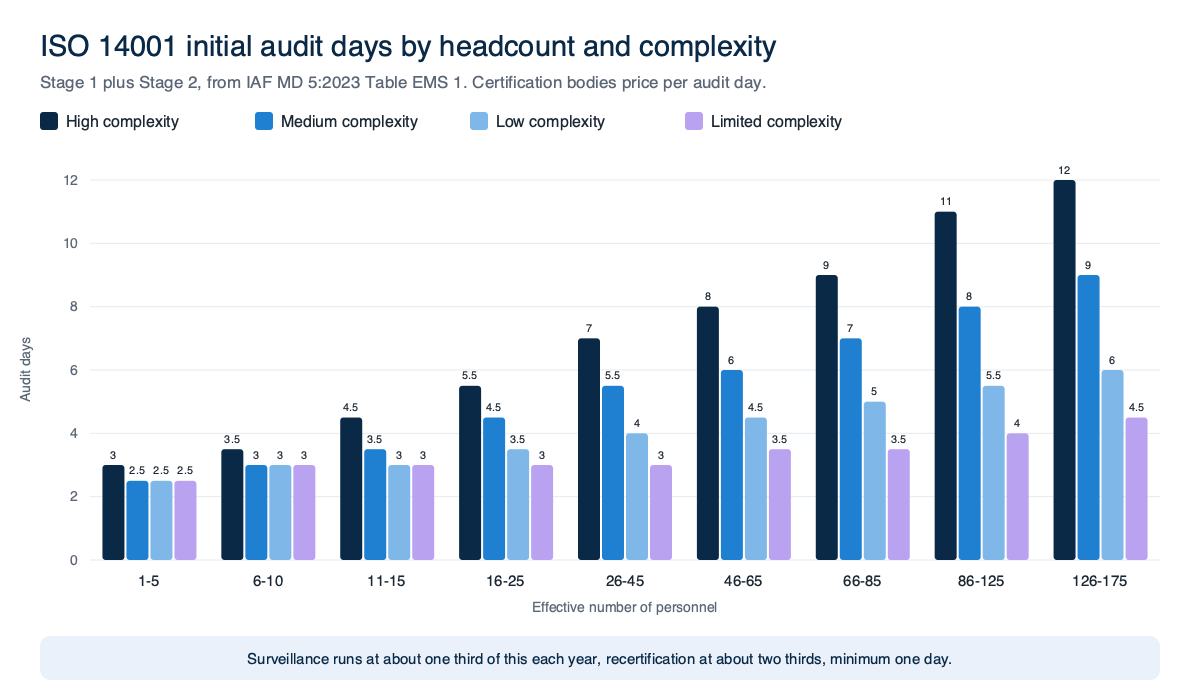
Certification bodies do not publish day rates, so the practical move is to get three quotes and divide each by the audit days in the table. A quote far below the calculated time is worth questioning, because an audit shorter than IAF MD 5 allows can undermine the accreditation of the certificate.
IAF MD 5 Table EMS 2 assigns ISO 14001 complexity by business sector, and the category can double the audit time for the same headcount. A few examples from the table:
A 20 person software or consulting firm is normally a limited complexity organisation and needs about 3 initial audit days. A 20 person food manufacturer is medium and needs about 4.5. The certification body makes the final call, and can adjust for multiple sites, shift work or significant regulated conditions.
An ISO 14001 certificate runs on a three year cycle: the initial Stage 1 and Stage 2 audit, a surveillance audit in each of the next two years, then recertification. IAF MD 5 puts each surveillance audit at about one third of the initial audit time and recertification at about two thirds, and says neither is likely to be less than one audit day. For a 20 person organisation, the audit days over a full cycle look like this.
| Year | What happens | Limited complexity | Medium complexity | High complexity |
|---|---|---|---|---|
| Year 1 | Stage 1 and Stage 2 certification audit | 3 days | 4.5 days | 5.5 days |
| Year 2 | First surveillance audit | About 1 day | About 1.5 days | About 2 days |
| Year 3 | Second surveillance audit | About 1 day | About 1.5 days | About 2 days |
| Year 4 | Recertification, new cycle begins | About 2 days | About 3 days | About 3.5 days |
Budget for the surveillance years from the start. An ISO 14001 certificate can be suspended if a surveillance audit is missed, and letting the environmental management system lapse between audits means paying close to implementation cost again at recertification. Internal audits and the management review also recur every year, as staff time.
ISO 14001 lead auditor certification is not the same thing, and the confusion inflates a lot of cost searches. ISO 14001 certifies an organisation's environmental management system. A person can only be certified as an auditor, through an internal auditor or lead auditor course sold by training providers. That training is useful if you want someone in-house to run internal audits, but it is a separate purchase and it does not certify your business.
Only an accredited certification body can issue an ISO 14001 certificate for an organisation. In the United States, ANAB is the main accreditation body, and accredited certificates can be checked through the IAF CertSearch database.
ISO published ISO 14001:2026 on 15 April 2026, replacing ISO 14001:2015 and its 2024 climate change amendment. Certification bodies including DNV describe a three year transition, and LRQA gives 30 April 2029 as the date by which 2015 certificates must transition. The changes are moderate: a wider view of environmental conditions such as biodiversity and resource availability, a stronger life cycle perspective, and new requirements for planning changes.
For a budget, the practical points are simple. If you are certifying for the first time, ask the certification body which edition it will audit against, because a 2015 certificate needs a transition audit before 2029. If you are already certified, the transition is usually handled at a scheduled surveillance or recertification audit, sometimes with extra audit time added.
The ISO 14001 certification body fee follows audit days, so the savings sit in preparation. Get three quotes and compare them per audit day. If you are also pursuing ISO 9001, an integrated audit under IAF MD 11 can reduce combined audit time by up to 20 per cent. Train an internal auditor rather than outsourcing every internal audit. And keep the scope honest, so you are not certifying sites no customer asked about.
Software is the other lever. CertAssist lists ISO 14001:2015 as live on its frameworks page as of October 2026, and lays out every clause with editable policy and evidence templates, documentation checklists and read-only auditor access, for a flat US$225 per month or US$2,475 per year as a launch offer. CertAssist has no integrations by design, which suits ISO 14001, where evidence is aspect registers, legal registers, monitoring records and minutes rather than cloud configuration.
Two honest limits. CertAssist does not replace the certification body, and no tool does. And if your environmental data already lives in an EHS platform with emissions tracking and permit workflows, a separate compliance tool may add little. CertAssist suits organisations of roughly 5 to 200 people certifying for the first time.
How much does it cost to get ISO 14001 certified?
A small US organisation of fewer than 10 people at one site should budget about US$5,000 to US$8,000 for initial ISO 14001 certification, based on published Amtivo figures. Larger or higher impact organisations pay more because IAF MD 5 gives them more audit days. Consultant support, if used, adds US$500 to US$1,500 per day on top of the audit fee.
How long does it take to get ISO 14001 certification?
Most small organisations take several months to reach ISO 14001 certification from a standing start, and larger or multi-site organisations often take a year or more. The audit itself is short, typically 2.5 to 5.5 days for up to 25 people. The time goes into identifying environmental aspects and legal obligations, then running an internal audit and management review.
How often are ISO 14001 audits required?
ISO 14001 requires an external surveillance audit every year in the two years after initial certification, then a recertification audit in the third year. IAF MD 5 sets surveillance at about one third of the initial audit time and recertification at about two thirds. Internal audits and a management review are also expected at planned intervals, usually at least once a year.
Does ISO 14001 certification expire?
An ISO 14001 certificate is valid for three years, provided each annual surveillance audit is passed. A recertification audit before expiry renews it for another three years. A missed surveillance audit or unresolved major nonconformity can lead the certification body to suspend or withdraw the certificate, so the three year validity is conditional rather than automatic.
Who provides ISO 14001 certification?
ISO 14001 certification is provided by accredited certification bodies, not by ISO itself, which only publishes the standard. In the United States, certification bodies are accredited by ANAB, and accredited certificates can be checked in the IAF CertSearch database. A certificate from a non-accredited body may be cheaper but is often not accepted by customers.
CertAssist lays out every ISO 14001 requirement, gives you editable policy and evidence templates, and lets your auditor review it all in one place, for a flat $225 a month.
See pricing FrameworksFlat $225 a month, or $2,475 a year (12 months for the price of 11). All prices in USD.