Real published numbers, the costs the software does not cover, and why most vendors in this category will not show you a price.
Compliance software for a small business typically costs somewhere between US$3,000 and US$30,000 a year, and most vendors in the category will not tell you which end you are at until you sit through a sales call. As of October 2026, CertAssist publishes a flat US$225 per month at its launch price (normally US$375 per month), or US$2,475 per year, with every framework included. Secureframe publishes a "starting at" figure of US$7,500 per year for its entry package. Vanta and Drata publish no list price at all. Whatever you pay for the platform, it will usually be the smallest line in your compliance budget: the independent audit and your own team's time cost more.
Compliance software pricing in this category falls into three shapes. A published flat fee, a published entry price with everything above it quoted, or no published price whatsoever. The table below shows what each vendor's own pricing page displayed when CertAssist checked it on 13 October 2026.
| Platform | Price published on its own site | What the pricing page shows |
|---|---|---|
| CertAssist | Yes, in full | US$225 per month at the launch price (normally US$375 per month), or US$2,475 per year. Every framework included. |
| Secureframe | Partly | Its Fundamentals package is listed as "Starting at $7,500/year". Its Complete and Defense packages are quoted after a demo. |
| Vanta | No | The plans page describes tiers and features but carries no dollar figure. Every path leads to a demo request. |
| Drata | No | The /pricing URL redirects to the homepage. The calls to action are "Get a Demo" and "Contact Sales". |
Figures here are taken directly from each vendor's own public pricing page on 13 October 2026 and may change. Any number you see quoted elsewhere for Vanta or Drata is a third-party estimate or a leaked quote, not a list price, and it will not be the number you are offered. That matters when you are building a budget you have to defend.
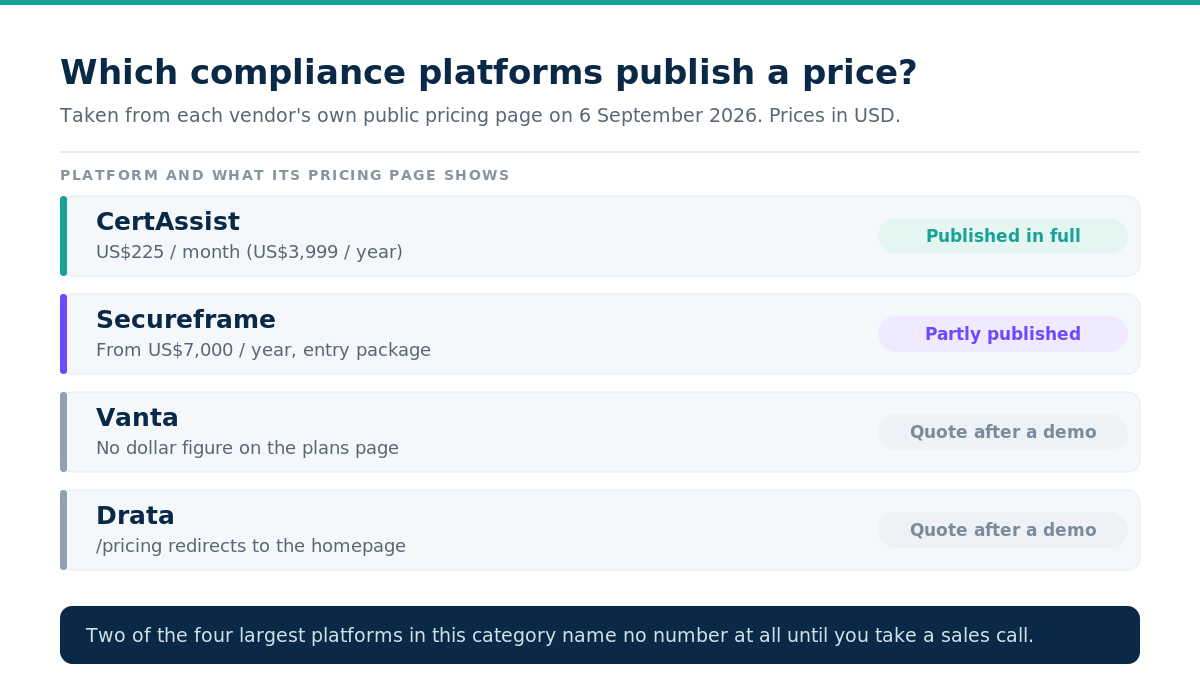
Hidden pricing in this category is a deliberate go-to-market choice, not an oversight. Quote-based pricing lets a vendor qualify the buyer before naming a number, price by headcount, framework count and perceived willingness to pay, and negotiate at the end of a quarter. It works well for a sales-led company selling to mid-market and enterprise buyers, and it is the reason the largest platforms in the category are unlikely to change it.
The cost lands on the buyer in three ways. You cannot budget before you have spent 30 to 60 minutes on a call. You cannot compare two vendors on the same axis. And you find out on renewal that the price moves with your headcount, often steeply, after you have already built your evidence in that system. None of this makes those platforms bad products. It does mean the sticker price is the last thing you learn rather than the first.
Compliance software is a workspace, not a certification. It lays out the controls, holds your policies and evidence, and gives your auditor somewhere to look. It cannot issue a certificate or a report. The independent audit is always a separate fee paid to a separate organization, and no platform on the market removes that requirement.
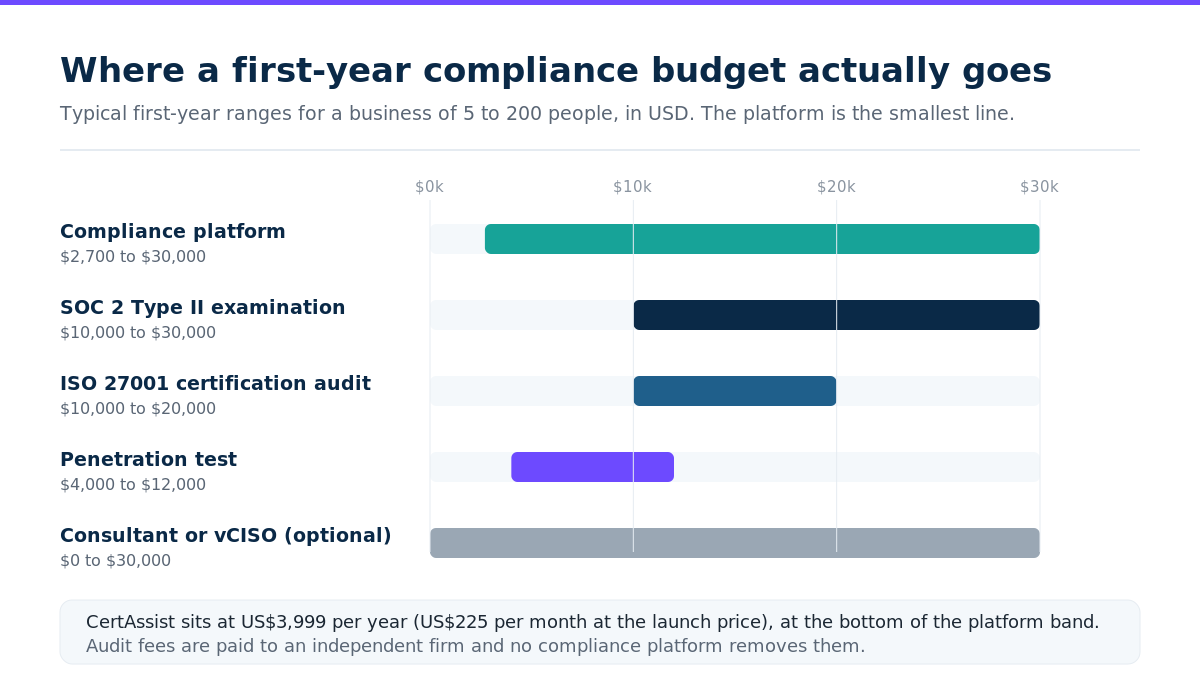
Here is what a realistic first-year budget contains for a business of 5 to 200 people, with the platform line shown for scale.
| Cost component | Typical first-year range (USD) | Who you pay | Can software reduce it? |
|---|---|---|---|
| Compliance platform | $2,700 to $30,000 | The software vendor | This is the line you control by choosing well |
| SOC 2 Type II examination | $10,000 to $30,000+ | An independent CPA firm | Indirectly. Cleaner evidence can lower audit hours |
| ISO 27001 certification audit (stage 1 and stage 2) | $10,000 to $20,000 | An accredited certification body | Indirectly, same reason |
| Penetration test | $4,000 to $12,000 | A security testing firm | No |
| Consultant or vCISO, if you use one | $0 to $30,000 | An advisory firm | Yes. Good templates reduce the hours you buy |
| Your own team's time | 100 to 400 hours | Nobody, but it is real | Yes, this is the main thing software is for |
| Remediation of whatever the audit finds | Highly variable | Depends on the gap | No |
Ranges for audit, penetration testing and remediation are commonly reported market figures for small organizations and vary widely by scope, region and firm. Get your own quotes before you commit. The pattern holds regardless: the platform is rarely more than a quarter of the first-year total, which is why paying a premium for the platform line is a poor way to spend a small compliance budget.
A small company getting its first certification usually lands between US$20,000 and US$50,000 in year one, all in. A common shape for a startup pursuing SOC 2 is a Type II examination around US$18,000 to US$25,000, a penetration test around US$6,000, a platform at US$2,475, and several hundred hours of internal time that never appears on an invoice but is the largest real cost in the project.
Year two is cheaper. The audit recurs, the platform recurs, and the internal time drops sharply because the policies exist and the evidence routine is established. The mistake small teams make is budgeting only for the software and being surprised by the audit invoice. The mistake larger teams make is the reverse: buying a platform priced for an enterprise program when the actual requirement is one certification to unblock one deal.
Yes, and it is worth being clear about what. The expensive platforms in this category are expensive largely because they integrate. They connect to your cloud accounts, identity provider and code repositories, then collect evidence automatically and monitor controls continuously. Vanta advertises integrations with 400 or more tools. That automation is genuinely valuable once you have hundreds of employees, several frameworks running at once and controls that drift faster than a human can check them.
CertAssist does not integrate with anything, by design. It does not connect to your systems and it does not pull your data, so evidence is gathered and uploaded by a person rather than collected automatically. What you get for that trade is a much lower price, nothing to configure, and no new vendor holding standing administrative access to your production environment. Third-party access is a leading breach vector, and a compliance platform with broad, permanent read access to your infrastructure is itself a piece of your attack surface. Whether that trade is right for you depends on your size, not on which vendor argues harder.
CertAssist is a poor fit in several situations, and it is better to say so than to sell into a bad outcome. If you are large enough that manual evidence collection genuinely does not scale, roughly a few hundred employees and up, automated collection earns its cost. If your buyers or your board expect continuous control monitoring with alerting, a no-integration tool cannot provide it. If you need integrated vendor risk management, a trust center and questionnaire automation in one system, the larger suites do more. And if you have no internal owner for the work at all, no platform at any price will save the project. Software organises the work; it does not do the work.
If, on the other hand, you are a team of 5 to 200 people who need ISO 27001 or SOC 2 to close deals, want a number you can put in a budget today, and would rather not grant another vendor access to your cloud, the cheaper end of the market is not a compromise. It is the correct purchase.
Compare on total first-year cost, not the monthly platform fee, and ask each vendor the same five questions before you sign.
CertAssist lays out every control in your framework, gives you editable policy and evidence templates, and lets your auditor review everything in one place. Flat US$225 a month at the current launch price, every framework included, no integrations and no system access.
See pricing FrameworksCompliance software for a small business typically costs between US$3,000 and US$30,000 a year. As of October 2026, CertAssist publishes US$225 per month at its launch price, normally US$375 per month, or US$2,475 per year with every framework included, and Secureframe lists its entry package from US$7,500 per year. Vanta and Drata publish no list price and quote after a sales call.
Compliance software is a workspace that lays out every control in a framework such as ISO 27001 or SOC 2, stores the policies and evidence that prove each control operates, and gives your auditor a single place to review it. It does not issue a certificate. The independent audit is always a separate engagement with a separate firm, and no software product replaces it.
You pick a framework, and the platform presents each control with the documentation and evidence it requires. You write or adapt the policies, upload the evidence against each control, and track what is still outstanding. Some platforms collect that evidence automatically through integrations with your cloud and identity systems. CertAssist does not integrate, so evidence is uploaded by a person and the platform never holds access to your systems.
Compliance as a service usually bundles a platform with consulting hours, and for a small business it commonly runs from about US$15,000 to US$50,000 a year depending on how much of the work the provider does for you. That is several times the cost of software alone, so it is worth separating the two lines: decide what you need a person for, then buy the platform separately.
A small company pursuing its first certification usually spends between US$20,000 and US$50,000 in year one once the platform, the independent audit, a penetration test and internal time are counted. The platform is normally the smallest line. Year two is cheaper because the policies already exist and the internal time drops sharply.
For the underlying standards themselves, the AICPA maintains the SOC suite of services, and ISO/IEC JTC 1/SC 27 is the committee responsible for ISO/IEC 27001. For framework-specific numbers, CertAssist has a full breakdown of what SOC 2 costs, what ISO 27001 certification costs and what PCI DSS compliance costs.
Flat US$225 a month launch price (normally US$375), or US$2,475 a year (12 months for the price of 11). All prices in USD.