Every HIPAA Security Rule safeguard a small business associate has to address, mapped to its CFR citation and the evidence that proves it, plus the items a five to fifty person SaaS team can leave off.
A HIPAA compliance checklist for a startup or SaaS vendor that handles protected health information (PHI) for a healthcare customer has five parts: a signed business associate agreement (BAA) with each customer and each subcontractor that touches PHI; a documented risk analysis; the administrative, physical and technical safeguards in 45 CFR 164.308, 164.310 and 164.312; written policies kept for six years under 164.316; and a breach process that notifies the customer within 60 calendar days of discovery under 164.410. The HIPAA Security Rule contains 18 standards and 36 implementation specifications, 14 required and 22 addressable. There is no HIPAA certification at the end of the checklist.
That last point shapes the whole HIPAA compliance checklist. The US Department of Health and Human Services (HHS) states that it does not endorse or recognise private "HIPAA certifications", so a HIPAA compliance checklist is a record of what you implemented and why, not a route to a certificate. What a healthcare customer actually checks is the signed BAA, your answers to its security questionnaire, and sometimes a SOC 2 report.
HIPAA applies to covered entities, which are health plans, healthcare clearinghouses and healthcare providers that transmit health information electronically in standard transactions, and to their business associates. A business associate is any vendor that creates, receives, maintains or transmits PHI on a covered entity's behalf. A SaaS company that hosts patient records, processes claims data or runs scheduling software for a clinic is a business associate. Since the 2013 Omnibus Rule, business associates are directly liable for complying with the HIPAA Security Rule, not only bound by the terms of the BAA.
A company that never handles PHI on behalf of a covered entity does not need a HIPAA compliance checklist. A consumer wellness app that collects health data directly from its own users is usually outside HIPAA, although other rules, such as the US Federal Trade Commission's Health Breach Notification Rule, may apply instead.
The HIPAA compliance checklist below covers what a small business associate has to address. Each line gives the regulation section, whether the HIPAA Security Rule marks it required or addressable, and the evidence a healthcare customer or investigator would expect to see. The citations follow the official text in the eCFR, 45 CFR Part 164 Subpart C.
| HIPAA checklist item | CFR citation | Status | Evidence to keep |
|---|---|---|---|
| Signed BAA with each healthcare customer | 164.504(e) | Required | Countersigned BAA per customer |
| BAAs with subcontractors that handle PHI, such as your cloud host | 164.308(b)(1), 164.314(a) | Required | List of subcontractors with a signed BAA for each |
| Named security official | 164.308(a)(2) | Required | Written appointment |
| Risk analysis of every system holding electronic PHI | 164.308(a)(1)(ii)(A) | Required | Dated risk register |
| Risk management plan | 164.308(a)(1)(ii)(B) | Required | Actions with owners and due dates |
| Sanction policy for staff who breach policy | 164.308(a)(1)(ii)(C) | Required | Policy and signed acknowledgements |
| Information system activity review | 164.308(a)(1)(ii)(D) | Required | Records of log and access report reviews |
| Joiner, mover and leaver access controls | 164.308(a)(3), (a)(4) | Standards required, specifications addressable | Access requests, removals and periodic access reviews |
| Security awareness and training | 164.308(a)(5) | Standard required, four specifications addressable | Training completion records |
| Security incident response and reporting | 164.308(a)(6) | Required | Incident procedure and incident log |
| Data backup, disaster recovery and emergency mode plans | 164.308(a)(7) | Required; testing and criticality analysis addressable | Plans and a dated restore test |
| Periodic evaluation of the program | 164.308(a)(8) | Required | Evaluation report |
| Workstation use and workstation security | 164.310(b), (c) | Required | Device policy and device management report |
| Disposal and re-use of devices and media | 164.310(d) | Required | Wipe or destruction records |
| Unique user IDs and an emergency access procedure | 164.312(a) | Required | User list and break-glass procedure |
| Audit controls that record activity in PHI systems | 164.312(b) | Required | Logging configuration and retention settings |
| Person or entity authentication | 164.312(d) | Required | Authentication settings, usually MFA enforcement |
| Encryption at rest and in transit | 164.312(a)(2)(iv), (e)(2)(ii) | Addressable | Encryption and TLS configuration |
| Policies and records retained for six years | 164.316(b)(2)(i) | Required | Version history of every policy |
| Breach notice to the covered entity within 60 days | 164.410 | Required | Breach procedure and notification template |
The two items small teams most often skip are the subcontractor BAAs and the risk analysis. A cloud provider, email service or support desk tool that stores PHI is a subcontractor and needs its own BAA. The risk analysis is the foundation that the other HIPAA safeguards are chosen from; the HIPAA risk assessment template shows one filled in for a 20 person company.
A required HIPAA implementation specification must be implemented as written. An addressable HIPAA implementation specification is not optional. Under 45 CFR 164.306(d)(3), the organisation must assess whether the specification is reasonable and appropriate for its environment, then either implement it, or document why it is not reasonable and appropriate and implement an equivalent alternative measure if one is.
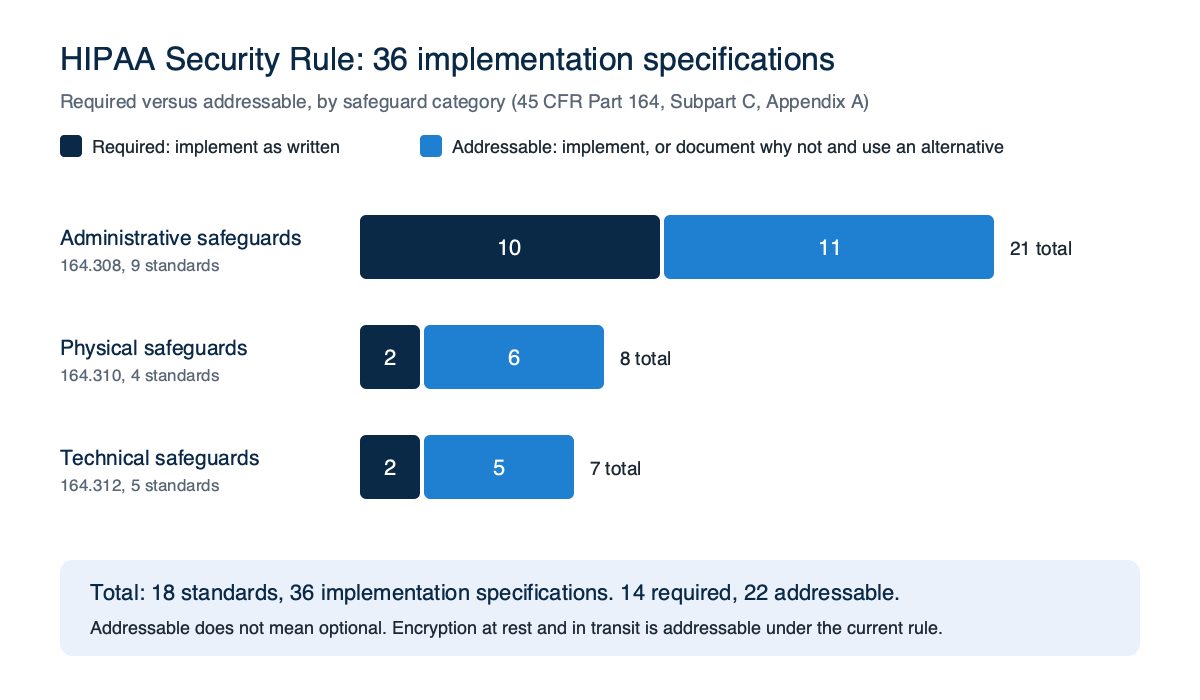
Encryption is the addressable HIPAA specification that matters most in practice. A lost laptop or leaked database containing PHI encrypted in line with HHS guidance is not "unsecured PHI", so the breach notification rules do not apply to it. The same loss without encryption usually means notifying the covered entity, which then notifies patients.
As of November 2026, the HHS proposal to overhaul the HIPAA Security Rule, published in the Federal Register on 6 January 2025, has not been finalised. The proposal would remove most of the distinction between required and addressable specifications. The current Security Rule still applies, but a small team building its HIPAA program now loses nothing by treating encryption and multi-factor authentication as required already.
A SaaS company running entirely on a major cloud platform can rely on the provider for most HIPAA physical safeguards at the data centre. That reliance only holds when the provider has signed a BAA with you and you use services the provider designates as eligible for PHI. Record the provider's BAA and its published security attestations as the evidence for those items.
The cloud provider does not cover anything you configure. Access to the cloud console, encryption settings, logging, backups and every laptop your staff use to reach PHI remain your responsibility under the HIPAA Security Rule. The workstation and device items in the HIPAA compliance checklist are where remote-first teams have the largest gaps.
A business associate with 5 to 50 staff can leave several items off its HIPAA compliance checklist:
The HIPAA evaluation standard at 164.308(a)(8) requires a periodic technical and non-technical evaluation, and another one whenever environmental or operational changes affect the security of electronic PHI. For a small business associate, a practical annual evaluation covers five things: refresh the risk analysis, run and record a backup restore test, review who has access to PHI systems, confirm every staff member completed training, and sample the audit logs to show someone reviews them.
Customers that want independent assurance often ask for a SOC 2 report that includes HIPAA-relevant controls, which requires an independent CPA firm; the SOC 2 vs HIPAA guide covers how the two overlap. Enforcement sits with the HHS Office for Civil Rights, which investigates complaints and breach reports. The NIST SP 800-66 Revision 2 guide is the most detailed free resource for mapping each HIPAA safeguard to practical activities.
CertAssist includes HIPAA as one of 14 frameworks in a single subscription, with each requirement laid out on one board, editable policy and evidence templates, an evidence checklist per control and read-only access for an assessor or customer reviewer. As of November 2026, CertAssist costs US$225 per month on a limited-time launch offer, normally US$375 per month. CertAssist does not connect to your cloud, identity provider or code, so it adds no new vendor with access to the systems that hold PHI, and the evidence you upload should never contain PHI itself.
CertAssist does not make an organisation HIPAA compliant, does not sign BAAs on your behalf and does not replace a risk analysis by someone who knows your systems. A larger organisation that wants continuous automated monitoring across many cloud accounts may be better served by an integration-based platform. The full first-year budget, including the costs that are not software, is in how much HIPAA compliance costs.
What is a HIPAA compliance checklist?
A HIPAA compliance checklist is a list of the HIPAA Security Rule, Privacy Rule and Breach Notification Rule requirements that apply to an organisation, with the evidence that shows each one is in place. For a business associate it covers BAAs, a risk analysis, the administrative, physical and technical safeguards in 45 CFR 164.308 to 164.312, six-year document retention and a 60-day breach notice to the covered entity.
Is HIPAA compliance mandatory?
HIPAA compliance is mandatory for covered entities, meaning health plans, healthcare clearinghouses and providers that conduct standard transactions, such as billing, electronically, and for business associates that handle protected health information on their behalf. Since the 2013 Omnibus Rule, business associates are directly liable under the Security Rule. A company that never handles PHI for a covered entity is not subject to HIPAA, although other health privacy rules may still apply.
How do you check HIPAA compliance?
HIPAA compliance is checked through the evaluation the Security Rule requires at 45 CFR 164.308(a)(8): a periodic technical and non-technical review of your safeguards, repeated after significant changes. In practice that means refreshing the risk analysis, testing backups, reviewing access and logs, and confirming training. HHS does not certify anyone as HIPAA compliant, so customers who want independent assurance usually ask for a SOC 2 report.
How often is HIPAA training required?
The HIPAA Security Rule requires a security awareness and training program for all workforce members but does not set a fixed frequency. The Privacy Rule requires covered entities to train new workforce members within a reasonable period and again when a material change affects their duties. Annual refresher training is the common practice most healthcare customers expect, and completion records are the evidence to keep.
How often should HIPAA policies be updated?
HIPAA requires policies to be reviewed periodically and updated as needed in response to environmental or operational changes, under 45 CFR 164.316(b)(2)(iii). The rule sets no fixed cycle, so most organisations review annually and after any significant change, such as a new system holding PHI. Every version must be kept for six years from creation or from when it was last in effect, whichever is later.
CertAssist lays out every HIPAA requirement with editable policy and evidence templates and read-only reviewer access, alongside SOC 2, ISO 27001 and every other supported framework, for US$225 a month. No integrations, no access to your systems.
See pricing FrameworksFlat $225 a month, or $2,475 a year (12 months for the price of 11). All prices in USD.