The IASME fee by organisation size, what Cyber Essentials Plus really costs, the budget lines nobody puts in the headline price, and whether a company outside the UK needs it at all.
As of November 2026, Cyber Essentials certification costs £320 to £600 plus VAT, a fee set by IASME, the NCSC's delivery partner for the scheme, according to how many people the organisation employs: £320 for 0 to 9 employees, £440 for 10 to 49, £500 for 50 to 249 and £600 for 250 or more. Cyber Essentials Plus has no national fee. Each certification body quotes for its own technical audit, and the lowest published Cyber Essentials Plus prices start at about £1,250 to £1,735 plus VAT for a small organisation. Both certificates last 12 months, so the Cyber Essentials certification cost is an annual cost, not a one-off.
The fee is the smallest part of the bill for many teams. The real Cyber Essentials budget also includes the time to answer the question set honestly and the cost of fixing what the questions expose, such as unsupported laptops or admin accounts used for everyday work.
The Cyber Essentials self-assessment fee is fixed by IASME and is the same whichever certification body marks the answers. The NCSC describes the Cyber Essentials fee as tiered by organisation size, "starting at £320 +VAT" (NCSC Cyber Essentials overview). The four bands below are IASME's published prices as reported by several licensed certification bodies in September to November 2026.
| Organisation size | Employees | IASME Cyber Essentials fee (ex VAT) | With UK VAT at 20% |
|---|---|---|---|
| Micro | 0 to 9 | £320 | £384 |
| Small | 10 to 49 | £440 | £528 |
| Medium | 50 to 249 | £500 | £600 |
| Large | 250 or more | £600 | £720 |
The Cyber Essentials fee buys one assessment. After payment, IASME opens an account on its assessment portal, and the organisation has six months to complete and submit the questions. An assessor from an IASME-licensed certification body then marks the answers, and a board member or equivalent signs the submission off. Some certification bodies sell packages that bundle the IASME fee with guidance, so the price a buyer sees from a certification body can be higher or, in at least one published case, slightly lower than the IASME list price.
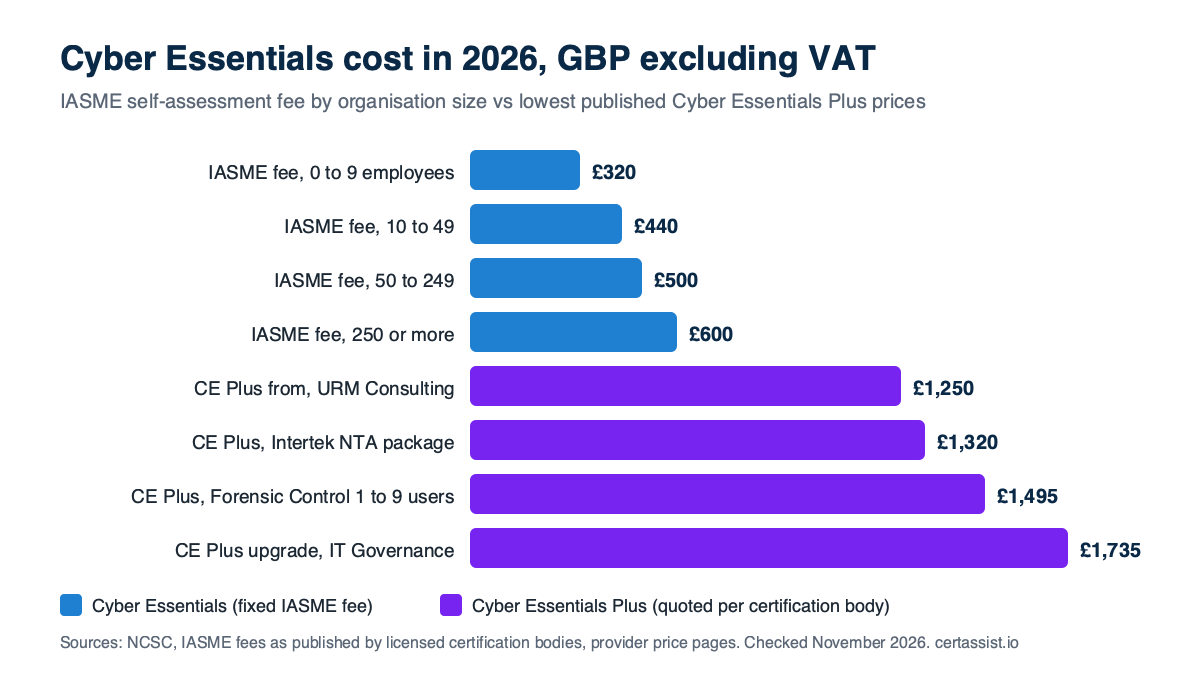
Cyber Essentials Plus costs more because an assessor tests the same five controls on a sample of real devices, internet gateways and internet-facing servers instead of relying on written answers. IASME states that a Cyber Essentials Plus assessment has to be quoted individually because the price depends on the size and complexity of the network, and the NCSC lists the Plus pricing approach simply as "Quoted". These are the lowest Cyber Essentials Plus prices published by certification bodies, as reported in November 2026.
| Certification body | Published Cyber Essentials Plus price (ex VAT) | What the price covers |
|---|---|---|
| URM Consulting | From £1,250 | A small, non-complex organisation; every assessment is quoted |
| Intertek NTA | £1,320 without support, £1,920 with support | Example package including the £320 Cyber Essentials fee, a small external scan and an onsite review of a few devices |
| Forensic Control | £1,495 for 1 to 9 users, £1,995 for 10 to 49 users | Includes the IASME fee and 12 months of vulnerability scanning |
| IT Governance | £1,735 | An upgrade for organisations certified to Cyber Essentials in the last three months, up to ten sample devices at one location |
Cyber Essentials Plus prices are not like for like, so compare what each quote includes: whether the basic Cyber Essentials fee is in the price, how many sample devices and sites are tested, whether the audit is remote or onsite, and what a retest costs if a device fails. The Cyber Essentials Plus audit must be completed within three months of the organisation's basic Cyber Essentials certificate, so the two are usually bought together or close together.
The IASME fee is the only fixed number in a Cyber Essentials budget. The other lines depend on how close the organisation already is to the five technical controls: firewalls, secure configuration, security update management, user access control and malware protection. This table sets out every cost component a small organisation should plan for.
| Cyber Essentials cost component | Typical amount (November 2026) | Who charges it |
|---|---|---|
| Cyber Essentials self-assessment fee | £320 to £600 + VAT, by employee count | IASME |
| Cyber Essentials Plus technical audit (optional) | Published prices from about £1,250 to £1,995 + VAT for up to 49 users; larger organisations are quoted | IASME-licensed certification body |
| Fixing gaps the question set exposes | From zero to the cost of replacing unsupported devices and software | Internal, or your IT provider |
| Your team's time | Not published; depends on how many devices and cloud services are in scope | Internal |
| Consultant or Cyber Advisor (optional) | Quoted by the provider; the NCSC offers a free 30-minute consultation for small businesses | NCSC-assured Cyber Advisor or consultant |
| Compliance platform (optional) | US$225 per month with CertAssist; Vanta and Drata do not publish list pricing | Software vendor |
| Annual renewal | The same IASME fee again every 12 months, at the size band that applies on renewal | IASME |
The most common surprise cost in Cyber Essentials is unsupported software. Every operating system and application in scope must be licensed and supported, with high-risk and critical security updates applied within 14 days of release, so an old laptop that can no longer receive updates either gets replaced or taken out of scope. Since 27 April 2026, assessments use IASME's Danzell question set against the NCSC's Requirements for IT Infrastructure v3.3, under which cloud services cannot be excluded from scope and the 14-day patching questions fail an assessment automatically.
A company outside the UK can get Cyber Essentials certification. IASME states that any organisation in the world can achieve Cyber Essentials provided it works with a UK-based certification body, and overseas applicants are allocated one automatically. The Cyber Essentials fee is charged in pounds sterling at the same size bands. Two things differ for a US or other non-UK company. The free cyber liability insurance is only for UK-domiciled organisations, and whether a Cyber Essentials Plus audit of overseas offices can be done remotely is worth confirming in the quote.
A US SaaS company usually meets Cyber Essentials for one reason: a UK customer, often in the public sector, defence supply chain or a regulated industry, has written "Cyber Essentials" into a contract or tender. In that case the buyer means the UK scheme, and a SOC 2 report or ISO 27001 certificate does not automatically satisfy the requirement, even though both cover far more ground.
Cyber Essentials is worth the cost when a customer or tender asks for it, because at £320 to £600 plus VAT it is one of the lowest-cost security certifications available and it removes a hard blocker from a deal. For a UK-domiciled organisation with turnover under £20 million that certifies its whole organisation, Cyber Essentials also comes with cyber liability insurance arranged by IASME, which the NCSC confirms includes 24/7 incident response support.
Cyber Essentials is not worth chasing when no customer has asked for it and the organisation sells mainly outside the UK. In that situation, money and time are better spent on the framework the buyers actually request, usually SOC 2 in the US or ISO 27001 internationally. Cyber Essentials is a baseline of five technical controls. Cyber Essentials does not cover risk assessment, supplier management, incident response planning or the management system that ISO 27001 requires, so Cyber Essentials will not answer an enterprise security questionnaire on its own.
Cyber Essentials is far cheaper than ISO 27001 or SOC 2 because Cyber Essentials checks five technical controls once a year, while ISO 27001 and SOC 2 examine a whole security program over time. The ISO 27001 certification cost breakdown and the SOC 2 cost breakdown set out those larger budgets. The fair conclusion for a small team is that Cyber Essentials sits alongside ISO 27001 or SOC 2 rather than replacing either of them: the work done for the five Cyber Essentials controls is reused as evidence for the matching ISO 27001 Annex A controls and SOC 2 criteria.
CertAssist does not issue Cyber Essentials certificates and does not replace IASME or the certification body that marks the assessment. CertAssist includes UK Cyber Essentials as one of the frameworks in a single subscription, broken into every requirement of the five controls, with evidence checklists and activity history on each one. CertAssist has no integrations and never connects to the systems being assessed. As of November 2026 CertAssist costs US$225 per month on a launch offer, normally US$375 per month, with every framework included, so a team preparing for Cyber Essentials and ISO 27001 at the same time pays one price. For a team that only needs a basic Cyber Essentials certificate once a year, the free IASME readiness material may be enough on its own, and a platform is optional. The compliance software pricing guide compares the wider market.
How much does Cyber Essentials Plus certification cost?
Cyber Essentials Plus has no fixed national price. Each IASME-licensed certification body quotes for the technical audit based on the number of devices, sites and internet-facing systems. As of November 2026, the lowest published Cyber Essentials Plus prices start at about £1,250 to £1,735 plus VAT for a small organisation, and one certification body publishes £1,995 plus VAT for 10 to 49 users. Check whether the quote includes the basic Cyber Essentials fee.
How long does Cyber Essentials certification last?
A Cyber Essentials certificate lasts 12 months from the date it is issued, and the same applies to Cyber Essentials Plus. To stay certified, the organisation completes a new assessment and pays the IASME fee again each year, at the size band that applies on renewal. Current certificates are listed in a public certificate search, so a lapsed Cyber Essentials certificate is visible to customers.
Do I need Cyber Essentials certification?
An organisation needs Cyber Essentials certification when a customer, contract or tender requires it. Cyber Essentials is common in UK central government, defence and public sector supply chains, and some private UK buyers now ask suppliers for it too. No law requires every business to hold Cyber Essentials. A company that does not sell to UK organisations rarely needs Cyber Essentials and should focus on the framework its own customers request.
Is Cyber Essentials worth it?
Cyber Essentials is worth it for most small organisations that sell into the UK, because the fee is £320 to £600 plus VAT and it can unblock a contract. UK-domiciled organisations under £20 million turnover that certify the whole organisation also receive cyber liability insurance arranged by IASME. Cyber Essentials covers only five technical controls, so it complements rather than replaces ISO 27001 or SOC 2.
How long does Cyber Essentials take?
Most of the time Cyber Essentials takes is preparation: checking devices, patching, removing unsupported software and tightening admin access. After paying the IASME fee, an organisation has six months to complete the self-assessment. Marking is quick once a complete submission is in, and some certification bodies advertise results within working hours or days. A Cyber Essentials Plus audit must follow within three months of the basic certificate.
CertAssist includes UK Cyber Essentials alongside ISO 27001, SOC 2 and every other supported framework, with evidence checklists per requirement and read-only access for your assessor, for US$225 a month. No integrations, no access to your systems.
See pricing FrameworksFlat $225 a month, or $2,475 a year (12 months for the price of 11). All prices in USD.