CCPA compliance software handles consumer requests, opt-outs and data mapping. Here is what the law requires and how to choose.
CCPA compliance software helps a business meet the California Consumer Privacy Act, as amended by the CPRA, by managing consumer rights requests, mapping where personal information lives, honouring opt-outs of sale or sharing, and keeping the records regulators expect. The right tool depends on where your effort actually goes: high volumes of data-subject requests point to a dedicated privacy-request platform, while the security foundation underneath, protecting the data you hold, is served by a compliance platform and a recognized certification. Here is what CCPA requires and how to choose software that fits.
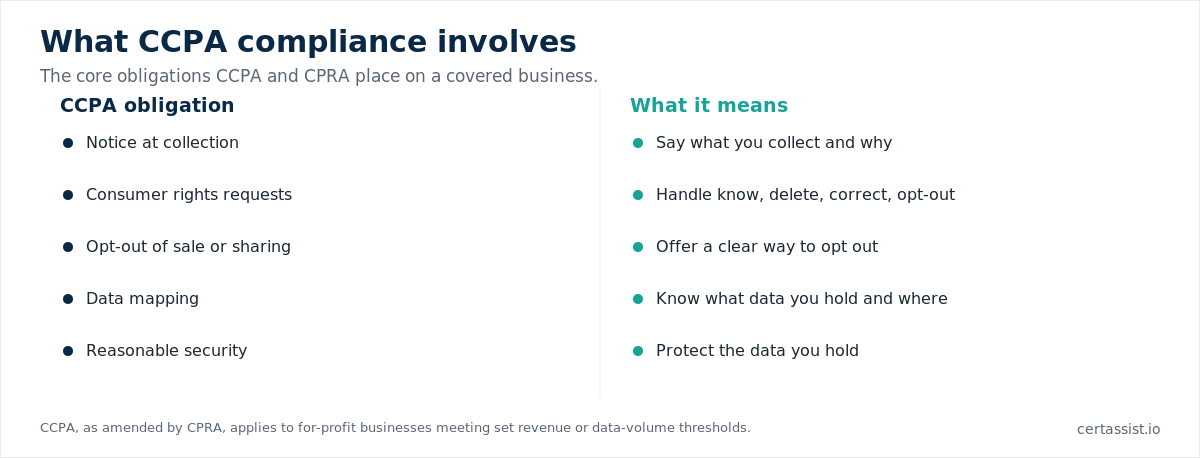
The CCPA is a California privacy law, strengthened by the California Privacy Rights Act, that gives California residents rights over their personal information and places duties on the businesses that handle it. It generally applies to for-profit businesses that do business in California and meet at least one threshold: gross annual revenue over 25 million US dollars, buying, selling or sharing the personal information of 100,000 or more consumers or households, or deriving half or more of revenue from selling or sharing personal information. If you meet a threshold, the obligations apply even if you are based outside California.
CCPA compliance requires giving consumers notice of what personal information you collect and why, and honouring their rights to know, delete, correct and opt out of the sale or sharing of their data. Behind those rights you must know what personal information you hold and where, which means data mapping, and you must protect it with reasonable security. You also need processes to receive and fulfill requests within the required timeframes and to keep records that show you did. The rights are the visible part; the data mapping and security underneath are the work.
CCPA compliance software typically automates the operational side of these duties. It provides intake for consumer rights requests, workflows to verify and fulfill them on time, consent and opt-out management including handling opt-out signals, and data-mapping to record what personal information you hold and where it flows. Some tools focus narrowly on data-subject requests, while broader privacy platforms add assessments and vendor management. The common thread is turning manual, deadline-bound privacy tasks into a tracked, auditable process.
Choose CCPA compliance software based on where your real workload sits. If you field many consumer rights requests, prioritize a dedicated privacy-request platform with solid intake, verification and fulfillment workflows. If your data estate is complex, weight data-mapping and discovery. If you also handle European users, look for a tool that covers GDPR too, since the obligations overlap heavily and doing both at once is efficient. And do not overlook the security foundation, because reasonable security is itself a CCPA expectation and the thing a breach will test.
CCPA and the GDPR overlap substantially, because both give individuals rights over their personal data and require businesses to handle it transparently and securely. The GDPR is broader and stricter in places, with a lawful-basis requirement and tighter consent rules, but the core building blocks, data mapping, rights requests, records and security, are shared. A business that has done the work for one has done much of the work for the other, which is why teams facing both usually tackle them together rather than as separate projects.
A compliance platform is not a substitute for a dedicated privacy-request tool, but it addresses the security foundation that CCPA assumes and that customers scrutinise. Reasonable security safeguards, access control, encryption, logging and incident response are the controls that protect the personal information CCPA is concerned with, and they are exactly what a compliance platform lays out and evidences. Pairing a privacy-request tool for the consumer-facing duties with a compliance platform for the security underneath covers both halves of the obligation.
CertAssist is not a CCPA data-subject-request tool, and it does not process consumer requests. What CertAssist does is lay out the security controls and privacy-adjacent frameworks that underpin any privacy program, including GDPR, which overlaps closely with CCPA, along with SOC 2 and ISO 27001, on one board with editable templates. That gives you the documented, reasonable security that CCPA expects and that buyers ask about, while you use a dedicated privacy tool for the request workflows. CertAssist does not connect to your systems, and the price is a published US$225 per month during its launch.
CCPA compliance software helps a business meet the California Consumer Privacy Act by managing consumer rights requests, honouring opt-outs of sale or sharing, mapping where personal information lives, and keeping the records regulators expect. Some tools focus on data-subject requests, while broader privacy platforms add assessments and vendor management.
The CCPA generally applies to for-profit businesses doing business in California that meet a threshold: over 25 million US dollars in annual revenue, handling the personal information of 100,000 or more consumers or households, or earning half or more of revenue from selling or sharing personal information. Meeting one threshold triggers the obligations, even for businesses based outside California.
No, but they overlap heavily. Both give individuals rights over their personal data and require transparent, secure handling. The GDPR is broader and stricter in places, including a lawful-basis requirement, but the core building blocks of data mapping, rights requests, records and security are shared, so work done for one covers much of the other.
Not strictly, but software helps once you receive meaningful volumes of consumer requests or hold a complex data estate, because the intake, verification, fulfillment deadlines and record-keeping are hard to manage by hand. Smaller businesses may manage with defined processes, while the security safeguards CCPA expects are served by a compliance platform regardless.
No. CertAssist is not a CCPA data-subject-request tool and does not process consumer requests. It lays out the security controls and overlapping frameworks such as GDPR, SOC 2 and ISO 27001 that underpin a privacy program, giving you the documented, reasonable security CCPA expects, while you use a dedicated privacy tool for the request workflows.
CertAssist lays out GDPR, SOC 2, ISO 27001 and more on one board with editable templates, for a published $225 a month during the launch.
See pricing FrameworksFlat $225 a month during the launch, normally $375, or $2,475 a year (12 months for the price of 11). All prices in USD.