The core policies every framework expects, mapped to ISO 27001 and SOC 2, and how editable templates get you there in days.
A usable information security policy set has five things: a short top-level policy that states management's commitment, a handful of topic-specific policies covering access control, acceptable use, incident response, vendor management and business continuity, a named owner for each one, a review date, and language your own staff can actually follow. If you are starting an ISO 27001 or SOC 2 project, you do not need forty pages on day one. You need the policies your auditor will check against a control, and they need to describe what your organization actually does, not what it aspires to do.
An information security policy set is not one document. It is a top-level policy plus a small number of topic-specific policies that between them cover every area an auditor will ask about. For a business of 5 to 200 people, the core set usually looks like this:
None of these need to be long. Auditors are not grading prose. They are checking that a document exists, that it is approved by someone with authority, that it matches what actually happens day to day, and that it has a review date attached.
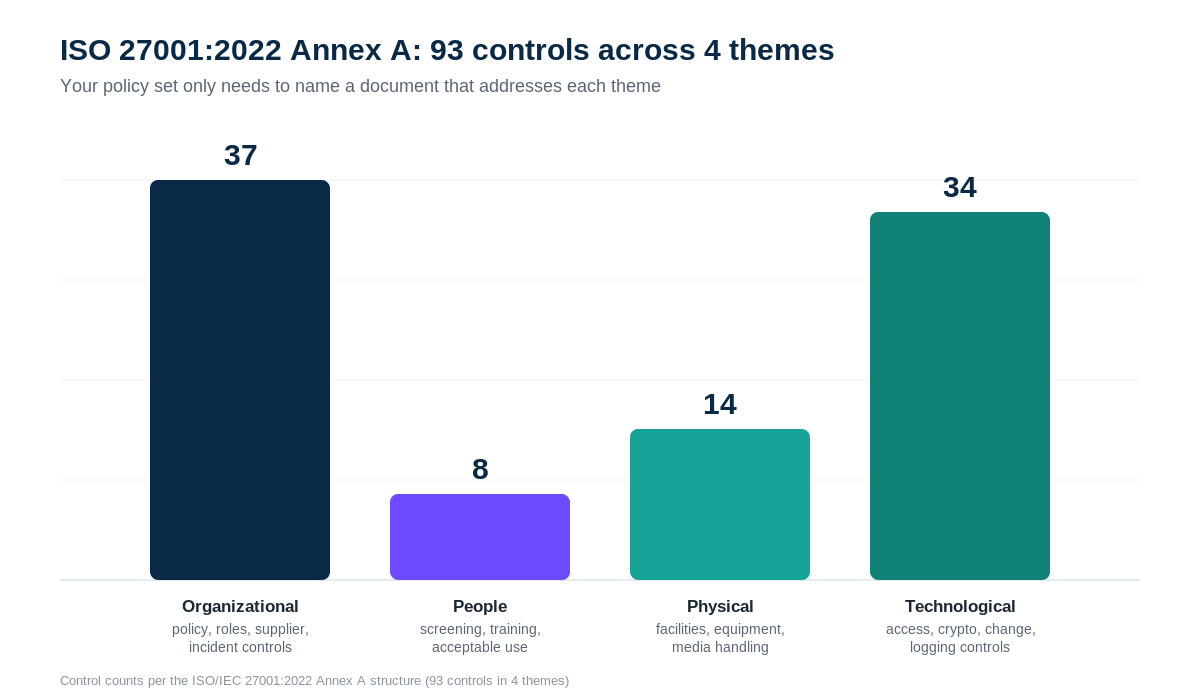
ISO 27001:2022 does not list "an incident response policy" as a named requirement. Instead, Annex A sets out 93 controls across four themes: organizational, people, physical and technological. Each policy document you write is really a way of demonstrating one or more of those controls are addressed. SOC 2 works similarly, through the AICPA's Trust Services Criteria rather than a numbered annex. The table below maps the core policy documents to both.
| Policy document | ISO 27001:2022 Annex A | SOC 2 Trust Services Criteria | Typical owner |
|---|---|---|---|
| Information security policy (top-level) | A.5.1 | CC1.1, CC1.2 | Leadership |
| Access control policy | A.5.15, A.5.18 | CC6.1, CC6.2, CC6.3 | IT / security lead |
| Acceptable use policy | A.5.10 | CC1.1, CC1.4 | HR / IT |
| Data classification policy | A.5.12, A.5.13 | CC6.1 | Security lead |
| Incident response policy | A.5.24 to A.5.28 | CC7.3, CC7.4 | Security lead |
| Vendor security policy | A.5.19 to A.5.22 | CC9.2 | Procurement / security |
| Business continuity policy | A.5.29, A.5.30 | A1.2 (availability) | Operations |
| Change management policy | A.8.32 | CC8.1 | Engineering lead |
Treat this as a starting map, not a legal opinion. Your auditor has the final say on whether a given document satisfies a given control for your specific Statement of Applicability or audit scope.
There is no required length in either framework. A workable top-level information security policy runs one to three pages. Each topic-specific policy, such as access control or incident response, usually fits on one or two pages once you strip out boilerplate. A complete first policy set for a company of 5 to 200 people is commonly 15 to 30 pages in total. Long is not the same as thorough. A 60-page policy manual nobody has read is worse evidence than a 20-page set your team can actually describe in an interview with the auditor.
A free information security policy template, such as the ones published by the NIST Computer Security Resource Center or industry bodies like SANS, costs nothing and gives you a reasonable starting structure. What it will not do is map itself to your specific framework's controls, track which sections you have actually customised, or hold the evidence that proves you follow the policy day to day. That gap is usually filled either by a compliance consultant, who drafts a tailored set for a fee, or by hours of unpaid internal time spent reading the standard and cross-referencing it yourself.
CertAssist sits between those two options. It gives you editable policy templates already mapped to the framework you are certifying against, alongside the evidence checklist for each control, for a flat US$225 a month at the current launch price (normally US$375 a month, see pricing). It does not replace legal review of your policies, and it does not remove the need for an independent auditor to examine the finished program. What it removes is the blank page.
ISO 27001 expects the top-level information security policy to be approved by top management, meaning someone with genuine authority over the business, not just the person who happens to run IT. SOC 2 does not name a specific title, but auditors want to see the policy endorsed by someone senior enough that it carries weight, commonly a CEO, CTO or a named security owner.
Both frameworks expect a documented review at least once a year. In practice you should also review a policy after any major change: a new system, a security incident, a change in headcount or organizational structure, or an update to the standard itself, as happened with the move from ISO 27001:2013 to the 2022 revision. Put the annual review on a calendar with a named owner. "We will get to it" is the single most common finding auditors report in this area.
This is the same structure CertAssist's editable templates follow for teams working through SOC 2 compliance software or an ISO 27001 program, so the policy set and the evidence behind it live in the same place your auditor reviews.
At least once a year, and again after any major change: a new system, a security incident, a change in headcount or structure, or an update to the framework you are certifying against. ISO 27001 and SOC 2 auditors both check the last review date on file, so put it on a calendar rather than leaving it to memory.
Someone with real authority over the business, not just IT. ISO 27001 expects top management to approve the top-level policy. SOC 2 does not name a specific title, but auditors want to see sign-off from someone senior enough that the policy carries weight, such as a CEO, CTO or designated security owner.
A policy states what the organization requires and why, in plain language a non-technical employee can follow. A standard sets the specific technical requirement, such as a minimum password length. A procedure is the step-by-step instruction for carrying it out. Most small teams only need the policy layer to start; standards and procedures can follow as the program matures.
There is no required length in ISO 27001 or SOC 2. A workable top-level policy runs one to three pages, and each topic-specific policy, such as access control or incident response, usually fits on one or two pages. A full first policy set for a small organization is commonly 15 to 30 pages in total, not hundreds.
Yes, as a starting point. Free templates from sources like SANS give you a reasonable structure, but they are generic: you still need to tailor every section to what your organization actually does, map each one to the specific controls your framework requires, and set up a way to track the evidence that proves you follow it.
CertAssist lays out every control, gives you editable policy and evidence templates instead of a blank page, and lets your auditor review it all in one place, for a flat US$225 a month at the current launch price.
See pricing FrameworksFlat US$225 a month launch price (normally US$375), or US$2,475 a year (12 months for the price of 11). All prices in USD.